



Taiwan Airspace Row: President Lai Ching-te Forced to Cancel Eswatini Visit Amid Unprecedented African Blockade
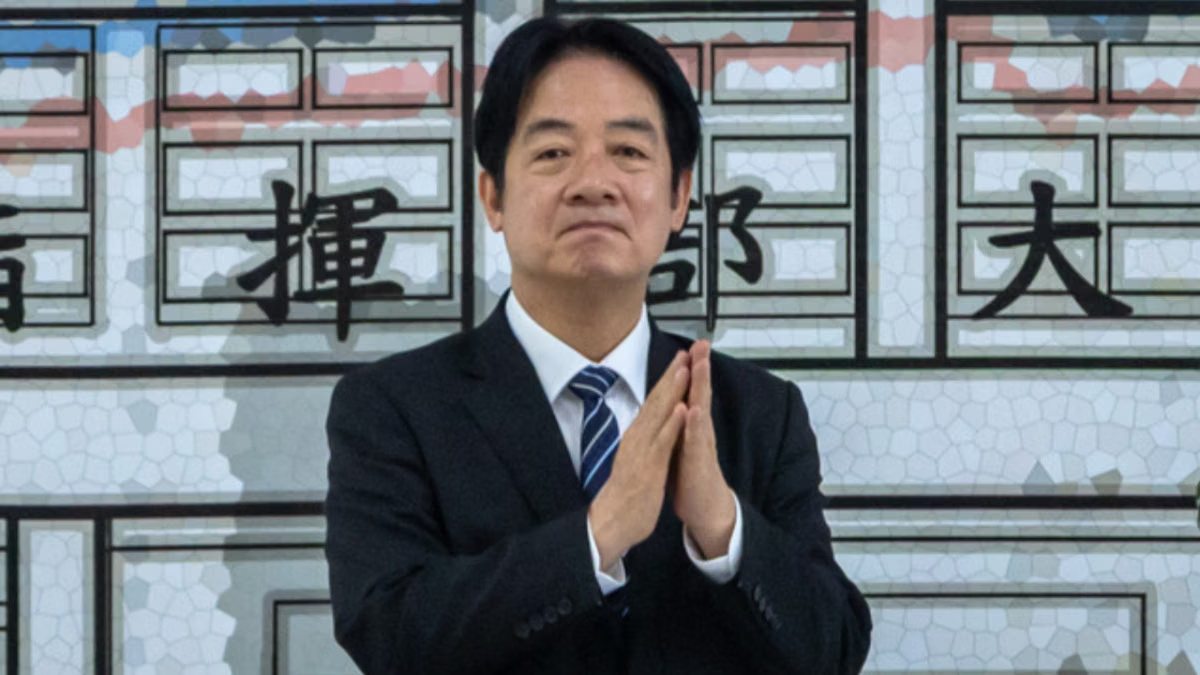
In what marks a dramatic and historic escalation of diplomatic warfare in the Indo-Pacific, Taiwan’s President Lai Ching-te has been forced to cancel his planned state visit to the Kingdom of Eswatini. The cancellation follows a coordinated revocation of overflight rights by three key African nations—Seychelles, Mauritius, and Madagascar—allegedly acting under intense economic and diplomatic pressure from Beijing.
This incident represents the first time a sitting Taiwanese president has been physically barred from reaching a diplomatic ally due to an “airspace blockade.” While Taiwan’s leaders have long faced challenges with transit stops (notably in the United States), the denial of simple passage through international flight corridors signals a new, more aggressive phase in China’s campaign to isolate the self-governed island.
The Domino Effect: Seychelles, Mauritius, and Madagascar
The presidential charter flight was scheduled to depart Taipei on Wednesday morning. However, less than 24 hours before takeoff, the Presidential Office in Taipei received urgent notifications. The nations of Seychelles, Mauritius, and Madagascar—all situated along the primary flight path to Southern Africa—unilaterally rescinded previously granted overflight permits.
Taiwan’s Foreign Minister, speaking at a midnight press conference, described the move as “diplomatic hijacking.” He stated, “The sudden reversal of these permits, without any technical or safety justification, points directly to external coercion. Beijing is no longer content with poaching our allies; they are now attempting to control the very air our leaders breathe.”
Economic Pressure: The “Belt and Road” Leverage?
Analysts suggest that the three African nations were presented with an “ultimatum” by Chinese envoys. Seychelles, Mauritius, and Madagascar have all seen significant Chinese investment over the last decade through the Belt and Road Initiative (BRI). Specifically, recent debt-restructuring talks in Madagascar and port development projects in Mauritius are believed to have been used as leverage to secure the airspace ban.
Beijing’s Response
Mainland China’s Ministry of Foreign Affairs has remained characteristically firm. A spokesperson in Beijing stated that the nations in question were simply “upholding the One-China Principle” and exercising their sovereign right to manage their own territorial airspace. “There is only one China in the world, and Taiwan is an inalienable part of it,” the spokesperson reiterated, adding that “any attempt to create ‘two Chinas’ is destined to fail.”
Impact on Taiwan-Eswatini Relations
Despite the cancellation, King Mswati III of Eswatini has reportedly reaffirmed his “ironclad” support for Taipei. However, the physical inability of President Lai to reach Mbabane highlights the logistical vulnerability of Taiwan’s remaining diplomatic ties. If air corridors can be shut down at will, the cost and risk of “shuttle diplomacy” for Taipei increase exponentially.
Strategic Implications: A New Precedent
The “Taiwan Airspace Row” of 2026 sets a dangerous precedent for international civil aviation. By politicizing overflight rights—usually a matter of routine international cooperation—Beijing has demonstrated that it can effectively ground Taiwanese diplomacy without firing a single shot. This “grey-zone” tactic bypasses military confrontation while achieving the strategic goal of total isolation.
Reactions from the International Community
- The United States: The State Department issued a “deeply concerned” statement, urging all nations to respect international aviation norms and “the freedom of movement for democratic leaders.”
- The European Union: A spokesperson for the EU called for “transparency” regarding the sudden revocation of flight permits, warning against the weaponization of economic ties.
- The African Union: Has largely remained silent, viewing the matter as a bilateral issue between individual member states and their respective partners.
President Lai Ching-te has reportedly decided to hold a virtual summit with King Mswati III instead, but the symbolic damage is done. The “Great Wall in the Sky” is now a reality that Taiwan’s diplomats must navigate as they move forward into an increasingly polarized 2026.