




CM Omar Abdullah Meets Home Minister Amit Shah: A Strategic Push for Statehood & Governance Reform
Inside the high-stakes New Delhi dialogue: Analyzing the future of Jammu & Kashmir’s “Business Rules” and the restoration of Statehood.
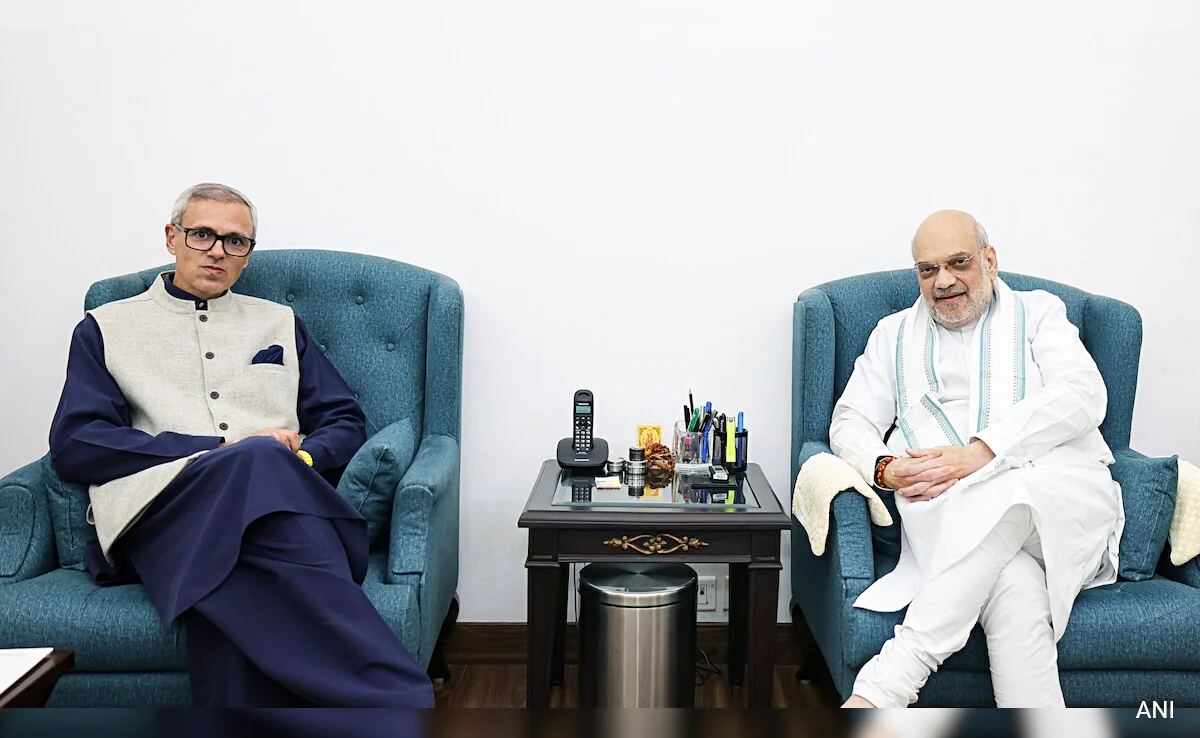
CM Omar Abdullah Meets Home Minister Amit Shah: A Strategic Push for Statehood & Governance Reform.
In a significant political development on Monday, May 11, 2026, the Chief Minister of Jammu and Kashmir, Omar Abdullah, called on the Union Home Minister Amit Shah in the national capital. The meeting, which lasted for nearly an hour at North Block, marks a pivotal moment in the relationship between the newly elected J&K government and the Centre. The discussions primarily centered on two tectonic pillars: the restoration of Statehood and the recalibration of the Transaction of Business Rules for the Union Territory.
The Core Agenda: Restoration of Statehood
Since the abrogation of Article 370 in August 2019, the restoration of statehood has been the primary demand of the National Conference-led government. During the meeting, CM Abdullah reiterated that the transition from a Union Territory back to a full-fledged State is not just a political requirement but a constitutional promise made by the Prime Minister on the floor of the Parliament.
Sources suggest that the Chief Minister presented a detailed memorandum emphasizing that a stable, elected government is now functional and that the “interim” status of J&K as a UT should be concluded to boost investor confidence and administrative efficiency.
Demystifying the “Business Rules” Conflict
One of the most complex issues discussed was the Transaction of Business Rules (2019). Currently, as a Union Territory, the Lieutenant Governor (LG) holds significant powers over civil services, police, and law and order. CM Abdullah discussed the “rationalization” of these rules to ensure that the elected cabinet has sufficient functional space to deliver on its electoral promises.
Key Administrative Points Discussed:
- Administrative Overlap: Resolving bottlenecks where files regarding public welfare are awaiting the LG’s nod.
- Reservation Policy: Discussions on the rationalization of the reservation framework to balance the interests of all communities in J&K.
- Financial Autonomy: Seeking a greater say for the state cabinet in the allocation of the UT budget.
The Telecom Power Debate: A Pragmatic Stance
Interestingly, Omar Abdullah adopted a pragmatic stance regarding recent orders granting the LG powers over telecom restrictions (internet shutdowns and telephone tapping). He stated that as long as security and law and order remain with the LG’s administration, it is “only logical” that telecom powers remain under that jurisdiction.
“These powers are directly linked to security. It would not be appropriate for the elected government to exercise such powers while responsibility for security remains outside its control,” Abdullah clarified, signaling a desire for cooperative federalism rather than immediate confrontation.
| Issue | Current Status (UT) | Proposed Change (Statehood) |
|---|---|---|
| Law & Order | Controlled by LG/Centre | Reverts to the Elected Govt. |
| Business Rules | LG has overriding powers | Cabinet-led decision making |
| Police/Services | Managed by MHA/LG | State Public Service Commission |
The Road Ahead for Jammu and Kashmir
Amit Shah reportedly assured the Chief Minister that the Union Government remains committed to the development of J&K. While no specific timeline for statehood was announced, the opening of a direct channel for discussing Transaction of Business Rules suggests a softening of the administrative gridlock that has characterized the region since the 2024 elections.
For the residents of the valley and the Jammu division, this meeting represents hope for a governance model that is more “Srinagar-centric” than “Delhi-dependent.” As the Chief Minister returns to Srinagar, the focus will now shift to the implementation of the agreed-upon administrative reforms.
© 2026 State Correspondents. All rights reserved. No part of this article may be reproduced without prior permission.