



Naval Blockade Declared: Trump Moves to Seal Strait of Hormuz After Peace Talks Fail

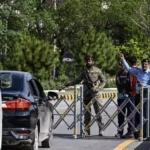
In a dramatic escalation of geopolitical tensions that has sent shockwaves through global energy markets, President Donald J. Trump has officially ordered the United States Navy to begin a naval blockade of the Strait of Hormuz. The directive comes in the immediate wake of the collapse of high-stakes, marathon peace negotiations in Islamabad, Pakistan, which ended early Sunday morning without a ceasefire agreement between the United States and the Islamic Republic of Iran.
The Islamabad Stalemate: Why Talks Collapsed
The negotiations, led by US Vice President J.D. Vance and Iranian Parliament Speaker Mohammad Bagher Qalibaf, lasted over 21 hours. Despite what sources described as “initial glimmers of hope,” the dialogue disintegrated over what the Trump administration termed Iran’s “unacceptable red lines.”
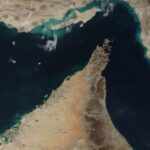
According to US officials, the “maximalist” demands of the Trump administration included a total cessation of uranium enrichment, the complete dismantling of major nuclear facilities, and the retrieval of all highly enriched uranium currently on Iranian soil. Furthermore, the US demanded that Iran waive all tolls for passage through the Strait of Hormuz—a strategic waterway through which nearly 20% of the world’s oil flows.
Iran, on the other hand, accused the US of “shifting goalposts.” Iranian Foreign Minister Abbas Araghchi stated that Tehran was “inches away” from a deal before encountering U.S. overreach. The primary sticking point remained the sovereignty of the Strait; Iran recently began charging transit fees, a move the U.S. decries as illegal under international maritime law.
“The Finest in the World”: Trump’s Blockade Order
Taking to social media and subsequent press briefings, President Trump was unequivocal. “Effective immediately, the United States Navy, the Finest in the World, will begin the process of BLOCKADING any and all ships trying to enter, or leave, the Strait of Hormuz,” the President declared. He specifically warned shipowners who have paid tolls to the Iranian government that their vessels are now subject to interdiction and seizure by American forces.
While the President’s initial statement suggested a total shutdown of the waterway, CENTCOM later clarified the scope. The blockade is intended to be “impartial” but specifically targets ships bound for or returning from Iranian ports. Freedom of navigation for vessels transiting to non-Iranian ports—such as those in Iraq, Kuwait, or the UAE—will reportedly be maintained, provided they do not comply with Iranian “illegal” toll demands.
Military Mobilization and Mine Clearing
The US Navy has already begun “clearing operations” in the Strait. Two American destroyers reportedly transited the waterway to neutralize mines allegedly laid by the Islamic Revolutionary Guard Corps (IRGC). The IRGC has responded with fierce rhetoric, warning that any challenge to their control of the waterway would result in a “deadly vortex” for enemy forces.
Admiral Brad Cooper of CENTCOM stated that the US military is prepared to “respond forcefully” to any hostile action. The operation marks the most significant naval confrontation in the region since the late 1980s, threatening to turn a regional “shadow war” into a full-scale maritime conflict.
Global Fallout: Oil Markets and Diplomatic Tensions
The impact on the global economy was instantaneous. Brent crude futures jumped over 7%, settling near $102 per barrel, while West Texas Intermediate (WTI) rose past $104. Analysts warn that if the blockade persists or leads to combat, prices could easily reach $120 to $150, threatening to derail the fragile global recovery.
Diplomatically, the US move has split its allies. While Israel has lauded the “maximal pressure” approach, several NATO allies—including Germany, the UK, and Japan—have expressed reluctance to join a formal blockade. German officials stated, “This is not our war,” highlighting a growing rift in the Western alliance over Trump’s Middle East strategy.
Tags:
Like and Follow State Correspondents Facebook Page Latest International News Iran US War Subscribe for alerts© 2026 State Correspondents. All rights reserved.