




Nepal Prepares To Allow Indian Currency Notes Above ₹100 After Nearly A Decade-Long Ban
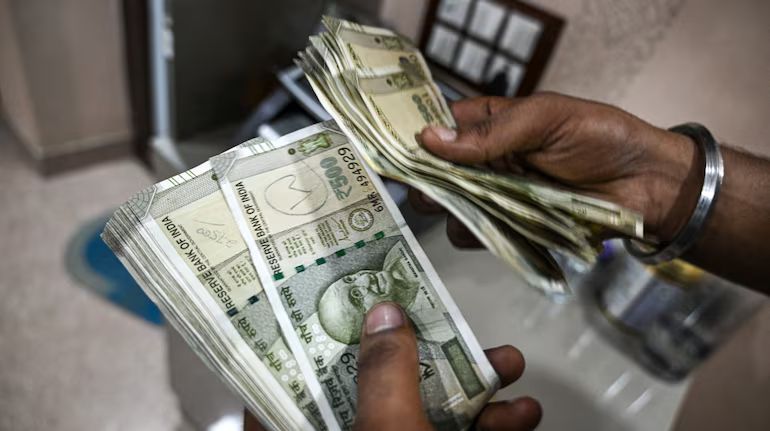
Nepal is in the final stages of allowing Indian currency notes above the ₹100 denomination to circulate legally again, a move expected to significantly ease travel, trade and remittances between the two neighbours. Nepal Rastra Bank (NRB), the country’s central bank, has said it is preparing to publish an official notification in the Nepal Gazette, after which detailed circulars will be issued to banks and financial institutions.
What Has Nepal Decided?
NRB officials quoted in local media said the central bank has “almost completed” internal procedures to lift the long‑running curb on accepting Indian notes above ₹100, introduced over concerns around demonetisation, counterfeit currency and regulatory mismatch. The new framework will formally recognise higher‑denomination Indian notes that are already widely used informally along the open border, bringing them into the legal banking system.
The initiative follows recent changes by the RBI, which amended India’s foreign exchange rules to allow travellers to carry Indian notes of ₹200 and ₹500 denominations to Nepal and Bhutan up to a limit of ₹25,000 per person. Nepal’s central bank had previously argued that it could not unilaterally accept such notes unless India provided clear legal backing and reciprocity for their use.
Background: Why Were High-Value Notes Restricted?
Nepal first imposed restrictions on Indian ₹500 and ₹1,000 notes in the early 2000s, citing worries over counterfeit bills and unregulated inflows of Indian currency. After a brief relaxation, the situation changed again when India announced demonetisation of old ₹500 and ₹1,000 notes in 2016, prompting NRB to halt transactions in those denominations to safeguard Nepal’s financial system.
In 2018, Nepal also officially banned the use of India’s newer ₹200, ₹500 and ₹2,000 notes, leaving only denominations of ₹100 and below as legal tender for cross‑border use. The clampdown created persistent difficulties for pilgrims, tourists, traders and workers who frequently cross the open Indo–Nepal border and rely heavily on cash.
How The New Rule Will Help
The planned relaxation is expected to make it much easier for Nepali migrant workers in India, Indian tourists visiting Nepal and border‑area traders to carry and use Indian currency without constant fear of confiscation or conversion losses. For tourism, officials believe the availability of higher‑denomination rupee notes will simplify spending for Indian visitors in hotels, restaurants, shops and pilgrimage centres such as Pashupatinath and Muktinath.
Economists note that legalising the use of widely‑circulated notes should reduce informal money‑changing on the border and allow more cross‑border currency to flow through regulated banking channels. At the same time, NRB is expected to maintain monitoring mechanisms and reporting requirements for banks to minimise the risk of money laundering or illicit flows.
What Will Still Not Be Allowed?
Reports suggest that while ₹200 and ₹500 notes will be freely usable within the prescribed limit, the status of the ₹2,000 denomination remains restricted and is unlikely to be encouraged given its limited circulation even inside India. Authorities have also indicated that the ₹25,000 per‑person cap on Indian currency will continue, meaning travellers cannot bring in unlimited volumes of cash despite the easing.
The upcoming NRB notification is expected to clearly spell out which denominations are valid, the carrying limits for individuals, and the procedures banks must follow while accepting and exchanging Indian currency. Until that circular is issued and implemented by financial institutions, the older rules technically remain in place and travellers have been advised to confirm with their banks and money‑changers before carrying large amounts.