




Iran, Oman Weigh Joint Hormuz Monitoring Plan as World Watches Key Oil Lifeline
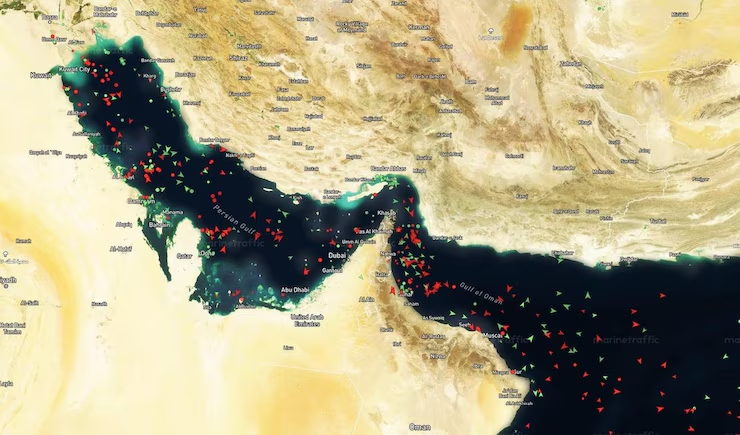
Iran says it is working with Oman on a new protocol to oversee shipping through the Strait of Hormuz, the narrow waterway that carries a major share of the world’s seaborne oil. Officials in Tehran present the idea as a step to “facilitate safe passage,” but the proposal comes in the middle of a war-time standoff with the United States, anxious energy markets and growing talk of multinational patrols in the Gulf.
Big Picture in Three Lines
- Iran’s deputy foreign minister says Tehran and Muscat are drafting a protocol to jointly supervise transit through the Strait of Hormuz, one of the world’s most critical oil chokepoints.
- Tehran insists the plan is about safer, more organised navigation, not fresh restrictions, but comes after weeks of shipping attacks and threats linked to the broader US–Iran confrontation.
- The move lands as Washington keeps up military pressure and warns of more strikes, while energy markets price every signal about when the strait might fully reopen.
Iran has announced that it is working with neighbouring Oman on a formal protocol to “supervise” and “coordinate” traffic through the Strait of Hormuz, the narrow sea lane at the mouth of the Gulf that has become a flashpoint of the current US–Iran crisis. The idea, floated by senior Iranian diplomat Kazem Gharibabadi and amplified by state media, immediately drew global attention because almost any change in how Hormuz is managed can ripple into oil prices, freight charges and the wider security debate around the Gulf.
Under the outline sketched so far, the two coastal states – Iran on the northern shore and Oman on the southern side – would develop a joint mechanism to monitor vessel movements and provide what Tehran calls “better services” to ships using the passage. Officials stress that such arrangements exist even in peacetime and argue that the current conflict simply makes codifying them more urgent. But the news broke at a moment when the waterway has witnessed missile strikes, drone attacks and mine fears, ensuring that the proposal is being read through a hard security lens as much as a technical one.
What exactly are Iran and Oman proposing?
In interviews to state-run media, Gharibabadi said the two countries are drafting a protocol that would set out how ship transits are logged, coordinated and escorted through the strait. The emphasis, in his telling, is on supervision and communication – ensuring that tankers, gas carriers and other vessels know which corridors to follow and which authorities to contact as they cross from the Gulf into the Arabian Sea or vice versa.
Crucially, Tehran has been at pains to claim this is not a new blockade regime. Iranian officials insist the goal is to “facilitate and ensure safe passage” and to offer more predictable pilotage, traffic control and emergency support for ships in a crowded and militarised waterway. In simple terms, Iran wants the world to see the plan as an administrative and safety upgrade that acknowledges the two states’ roles as coastal guardians rather than an attempt to shut out rivals.
Muscat, long seen as a discreet mediator in Gulf crises, has confirmed that it is exploring “arrangements” to help reopen and stabilise shipping through Hormuz, but has not spelled out details or publicly endorsed every element of Tehran’s concept. That ambiguity leaves room for diplomacy – and for nervous questions in Western capitals about how such a scheme would operate in practice.
Why Hormuz matters so much to the world
The Strait of Hormuz is often described as the world’s most important oil chokepoint – and not without reason. Before the current escalation, an estimated 20 million barrels of oil a day, plus large volumes of liquefied natural gas, crossed its narrow waters, linking producers in Saudi Arabia, the UAE, Kuwait, Iraq, Qatar and Iran to customers from Asia to Europe. When that artery is disrupted, energy markets feel the shock almost immediately.
Since late February, the waterway has been at the centre of a wider conflict triggered when the United States and Israel launched major strikes on Iranian targets, prompting missile and drone retaliation and threats from Tehran to block “hostile” shipping. Iran has been accused of attacking tankers, deploying naval mines and even demanding huge fees from some vessels seeking safe passage, creating a de facto choke on traffic that has driven up freight and insurance costs.
The result has been an unprecedented squeeze on maritime flows, with many tankers diverted, delayed or left idling while governments and companies assess the latest risk calculations. Oil prices surged sharply in the immediate aftermath of the escalation and have swung with each new headline about potential ceasefires, new strikes or shipping initiatives. Any sign that Hormuz might reopen more fully – or close more tightly – instantly feeds into trading screens and fuel price projections.
US pressure and global scepticism
Iran and Oman’s emerging plan has to be read against the backdrop of aggressive US messaging. President Donald Trump has repeatedly threatened to destroy Iranian power plants and other infrastructure if Tehran does not restore freedom of navigation, even publicly setting deadlines and calling for a multinational naval coalition to secure the strait. Washington has already conducted strikes on Iranian assets it says are involved in mine-laying and attacks on shipping.
For US officials and some European allies, any Iran-led monitoring mechanism risks being perceived as granting Tehran formal leverage over a global artery it has already tried to squeeze. They worry that “supervision” could slide into selective denial of access for vessels from countries deemed unfriendly, especially if the broader war continues and confidence between Tehran and the West erodes further.
That explains why, even after reports of the draft protocol emerged, diplomats in Washington, Brussels and Gulf capitals continued exploring alternative options – from multinational escort missions to rerouting part of energy exports through pipelines and other ports. In short, no major consumer wants to rely solely on assurances from a state currently at war with the United States and in a direct standoff with Israel.
Oman’s balancing act in a dangerous neighbourhood
For Oman, the strait is both an economic windfall and a strategic burden. The sultanate’s Musandam governorate overlooks the shipping lane, and Omani waters traditionally handled the bulk of the deepest-draught traffic. When the route is open, Oman benefits from bunkering, port services and its reputation as a calm, neutral neighbour. When it is militarised, Muscat faces the risk of spillover and the daunting task of managing expectations from all sides.
Analysts note that Oman’s foreign minister has promised “arrangements” to help unblock Hormuz but is wary of any outcome that looks like endorsing permanent Iranian control or inviting a US ground intervention on nearby islands that Tehran occupies but the UAE claims. The sultanate’s long-standing diplomatic brand is built on quiet mediation and non-alignment; its goal now is to channel that credibility into a formula that lowers tensions without leaving it trapped between two angry powers.
That is one reason Muscat is likely to frame any protocol as strictly technical – focused on pilotage, traffic separation and emergency coordination – while leaving political questions such as sanctions, military presence and war termination to bigger multilateral forums. Whether other regional states accept that framing will determine how far the Iran–Oman initiative can go.
Cyber and hybrid warfare in the background
Even as the world debates shipping lanes and naval escorts, a parallel struggle is playing out in cyberspace. Iranian-linked hackers have been accused of wiping data at dozens of Israeli companies and compromising security cameras, part of a broader pattern of digital attacks that track spikes in military tension. These operations do not directly close Hormuz, but they contribute to the climate of uncertainty in which shipping, insurance and energy decisions are made.
Cyber strikes against logistics firms, port operators or energy traders could, in theory, disrupt flows even if the waterway itself is technically open. That is why many security experts now treat cyber resilience, maritime surveillance and naval patrols as three interlocking pillars of any credible plan to keep Hormuz functioning in a crisis. Iran and Oman’s proposed monitoring protocol may address only one of those fronts, leaving the others to be handled by separate coalitions and defensive efforts.
What it means for energy markets and countries like India
For major importers such as India, China, Japan and European economies, any signs of stability in Hormuz are welcome – but they will be judged by outcomes, not statements. India, which relies heavily on Gulf crude, has already had to monitor price spikes, rerouting and insurance issues since the current crisis began. A functioning, predictable transit regime under a joint Iran–Oman umbrella could ease some of that pressure, provided it is transparent, non-discriminatory and respected by all major players.
In the near term, energy analysts say markets will focus on three signals: whether actual tanker traffic picks up after the protocol is announced; whether attacks on ships decline; and whether the United States softens or hardens its rhetoric in response. A genuine increase in safe passages, combined with fewer incidents and quieter threats, would allow prices to drift down from crisis highs. The opposite mix – a protocol on paper but continued strikes and ultimatums – would reinforce the impression that the proposal is more about messaging than real de-escalation.
Can a joint protocol really lower the temperature?
The honest answer is that a bilateral monitoring plan can help, but cannot by itself end the crisis. In the best case, a clear and jointly implemented Iran–Oman protocol could reduce misunderstandings in the strait, give ship captains more confidence about routes and contacts, and offer a framework for quickly investigating incidents before they spiral. It might also give outside powers a reason to slow-talk military options while they test whether diplomacy at sea can work.
However, the deeper drivers of this confrontation lie in unresolved disputes over Iran’s nuclear programme, regional influence and relations with the United States and Israel. As long as those fault lines remain raw – and as long as military strikes, cyber operations and proxy clashes continue – any arrangement for Hormuz will operate under extreme stress.
For now, the emerging protocol is best understood as one piece on a crowded chessboard: an attempt by Iran to recast itself as a responsible coastal state, by Oman to protect its neighbourhood, and by energy-dependent economies to find any flicker of stability in an unpredictable corridor. Whether that piece brings the region closer to de-escalation or simply buys time in a longer struggle will become clear only in the weeks ahead as ships test the waters – literally and politically.
Tags:
Like and Follow State Correspondents Facebook Page Latest International News Iran US War Subscribe for alerts© 2026 State Correspondents. All rights reserved.