




3.9‑Magnitude Earthquake Jolts Jammu & Kashmir; No Major Damage Reported
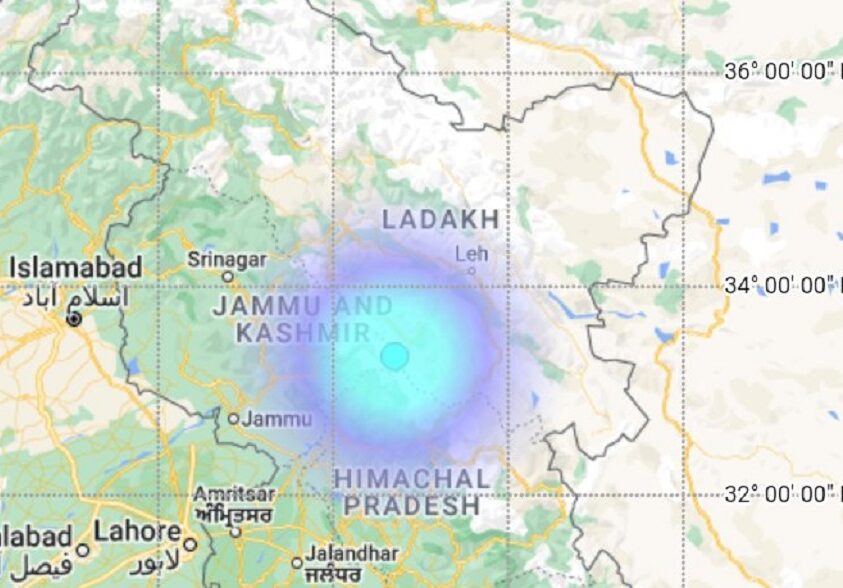
Jammu & Kashmir A 3.9‑magnitude earthquake jolted parts of Jammu & Kashmir on Friday, sending light tremors across several districts, but as of early evening no major damage or casualties have been reported, local authorities and the National Center for Seismology (NCS) said. The tremor was felt for a few seconds in both the Jammu and Kashmir divisions, prompting residents to rush out of homes and offices, with most people returning only after confirming that the shaking had subsided.
Epicentre, time and intensity
According to data from the NCS, the earthquake occurred at a shallow depth, striking around mid‑morning on April 4, 2026, in the Himalayan seismic belt that runs through Jammu & Kashmir. The recorded magnitude was 3.9 on the Richter scale, which is classified as a “minor” to “light” quake and typically causes noticeable shaking but limited damage in well‑constructed areas.
Early reports suggest that the tremors were most strongly felt in hilly districts and towns along the Jammu‑Kashmir axis, where residents reported swaying of buildings, creaking doors and windows, and vibrations similar to a passing heavy truck. Seismological stations across the region registered the shock, and the NCS has initiated a rapid review of the data to refine the exact coordinates and depth of the event.
Administration response and no‑damage confirmation
Local administration officials in key districts have been put on alert, with emergency‑response teams instructed to inspect critical infrastructure such as government buildings, hospitals, bridges, and power stations. Initial ground reports indicate that while the tremors caused momentary panic, there is no structural collapse or serious injury reported so far, and essential services continue to function normally.
“Several people reported the shaking, but our teams have not received any confirmation of fatalities or major property damage,” a senior official from the Jammu & Kashmir relief and disaster‑management department told this portal. “We are monitoring the situation round‑the‑clock and will immediately issue alerts if aftershocks or any unusual activity is observed.”
Residents’ reactions across the valley and Jammu region
In both the Kashmir Valley and the Jammu region, residents shared videos and messages on social media describing the experience of the tremors. Many recounted stepping out onto streets or balconies as furniture and objects trembled, noting that the shaking lasted only about 10–20 seconds but was enough to unsettle nerves, especially in high‑rise buildings.
Some older residents, however, noted that this type of moderate tremor is not uncommon in the region, given its location along the active Indian–Eurasian plate boundary. Still, the event has reignited debates about earthquake‑resilient construction and the need for wider public‑awareness programmes on what to do before, during, and after a quake.
Geological backdrop: Why J&K is seismically active
Jammu & Kashmir lies in Seismic Zone V, the highest‑risk category in India’s earthquake zoning map, due to its position at the collision front of the Indian and Eurasian tectonic plates. This region is prone to frequent small to moderate quakes, with occasional stronger events generated by strain release along major fault lines.
Seismologists explain that even a 3.9‑magnitude event is a reminder of the ongoing tectonic stress in the area and can serve as a “wake‑up call” for local authorities to strengthen building‑code enforcement, retrofit vulnerable structures, and upgrade early‑warning and communication systems. The NCS has in the past emphasised that shallow‑focus quakes in the Himalayas can feel intense even at moderate magnitudes because of the near‑surface origin.
| Event parameter | Details (preliminary) |
|---|---|
| Magnitude | 3.9 on Richter scale |
| Region affected | Parts of Jammu and Kashmir; tremors felt in both Jammu and Kashmir divisions |
| Depth | Shallow (exact depth under review by NCS) |
| Damage reported | No major structural damage or casualties so far |
| Administrative response | Alert status in local districts; emergency teams monitoring infrastructure |
Push for earthquake‑resilient infrastructure
Officials and disaster‑management experts have used this tremor as an opportunity to reiterate the importance of “earthquake‑resilient” construction practices in Jammu & Kashmir. They stress that the Union Territory’s rapid urbanisation, including the growth of multi‑storey buildings in towns such as Srinagar, Jammu, and Udhampur, makes strict adherence to seismic‑safety norms crucial.
Authorities have also urged citizens to keep “emergency kits” at home—containing water, basic medicines, a torch, and important documents—and to participate in or inquire about local disaster‑respond training programmes, especially in vulnerable mountainous and valley‑side settlements.
Monitoring aftershocks and public communication
Following such events, seismologists typically monitor for aftershocks, which are smaller quakes that occur after the main shock as the crust adjusts to stress redistribution. The NCS has advised the public to remain alert but not to panic, noting that the majority of aftershocks in this magnitude range tend to be weaker than the initial event.
State‑level disaster‑management agencies are coordinating with the NCS to ensure that any unusual activity is immediately communicated to local administrations, police, health services, and the media. For residents, the message is to stay informed through official channels, avoid sharing unverified rumours on social media, and report unusual tremors or structural cracks to local authorities.
Recent context: other quakes in the region
This 3.9‑magnitude tremor comes in the context of a series of recent seismic events in and around Jammu & Kashmir. Earlier in the year, a 4.2‑magnitude earthquake jolted the Doda district, also causing shaking but without major damage, while stronger quakes in the Hindu Kush region of Afghanistan have sent reverberations across North India, including Jammu & Kashmir, Delhi‑NCR, and Punjab.
These repeated but largely non‑destructive events underline the fact that the region experiences frequent low‑to‑moderate shaking, yet remains relatively lucky in avoiding catastrophic losses—so far—because of the shallowness and moderate size of most quakes and the limitations of the current built‑environment.
Advice for residents after a light earthquake
Expanding on official NCS and disaster‑management guidelines, experts list several practical steps citizens can take after a minor quake like this 3.9‑magnitude event:
-
>Check your home or office for visible cracks in walls, ceilings, or pillars and report serious structural issues to local authorities.
>Inspect gas connections and electrical fittings for any signs of leakage or damage before resuming normal use.
>Keep mobile phones charged and have a battery backup or power bank ready in case of a more severe event.
>Stay tuned to official updates from the NCS, the Union Territory administration, and local radio or TV channels, rather than relying solely on social‑media rumours.
For parents and teachers, this is also an opportunity to run brief drills with children: showing them how to “Drop, Cover, and Hold On” during shaking and to avoid running outside during the actual tremor.
Tags:
Like and Follow State Correspondents Facebook Page Latest International News Iran US War Subscribe for alerts© 2026 State Correspondents. All rights reserved.