



Russia-India defence talks gather pace as Denis Manturov lands in Delhi for high-level strategic meetings
Russian First Deputy Prime Minister Denis Manturov arrived in New Delhi on April 2 for a packed schedule of consultations with India’s top leadership, putting defence cooperation, energy security, trade expansion and wider regional stability at the centre of the bilateral agenda.
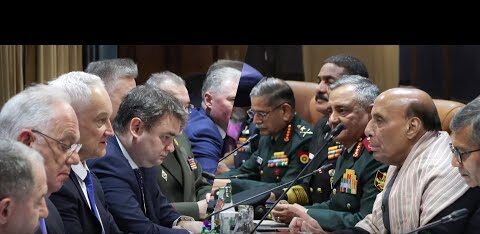
In a significant diplomatic development with clear implications for the strategic landscape of Asia, Russian First Deputy Prime Minister Denis Manturov arrived in New Delhi early on Thursday for a series of high-level discussions focused on defence, security, energy and trade. The visit comes at a time when India and Russia are recalibrating their partnership against the backdrop of global supply-chain stress, regional instability and shifting geopolitical equations. For policymakers in both capitals, the visit is not merely ceremonial. It is being viewed as a working engagement intended to examine what is functioning well in the partnership, where cooperation needs fresh momentum, and how both countries can preserve strategic depth in a volatile international environment.
The Ministry of External Affairs formally welcomed Manturov to the national capital and underlined that he would hold consultations with External Affairs Minister Dr S. Jaishankar while also participating in other bilateral engagements. Officials indicated that the talks were expected to focus strongly on defence and security cooperation. Manturov is also scheduled to meet National Security Advisor Ajit Doval and Finance Minister Nirmala Sitharaman, signalling that the agenda goes well beyond one sector and touches broader questions of national strategy, economic resilience and long-term statecraft.
- Review of defence and military-technical cooperation between India and Russia.
- Assessment of strategic and security concerns arising from regional tensions.
- Talks on energy flows, including the significance of Russian crude supplies to India.
- Broader trade and economic coordination under established intergovernmental mechanisms.
Why this visit matters now
Timing often tells its own story in diplomacy, and Manturov’s India visit is no exception. The discussions are taking place soon after senior officials from both countries reviewed bilateral ties in foreign office consultations held in New Delhi on March 30. Those consultations, co-chaired by Foreign Secretary Vikram Misri and Russian Deputy Foreign Minister Andrey Rudenko, examined the state of the relationship and exchanged views on major regional and global developments. The arrival of Manturov only days later suggests both governments are keen to convert institutional dialogue into concrete political coordination.
Another reason the visit is receiving close attention is the intersection between strategic cooperation and energy security. Officials noted that Russia has once again emerged as the largest supplier of crude oil to India in recent weeks following a temporary waiver connected to United States sanctions. That development gives the current talks added importance because energy affordability, shipping continuity and payment stability now overlap with wider geopolitical risk calculations. As a result, the Manturov visit sits at the crossroads of defence planning, economic pragmatism and foreign policy balancing.
Defence remains the core pillar
Even as India expands its strategic partnerships with multiple global powers, Russia continues to remain a major pillar in India’s long-standing defence architecture. The present round of talks is therefore expected to examine not just past procurement or inventory issues, but the future shape of military-technical cooperation. That includes questions related to maintenance support, supply-chain reliability, modernisation pathways, technology collaboration and the operational readiness of legacy platforms that remain important to India’s armed forces.
For India, the central challenge is practical rather than ideological: how to secure timely access to defence systems, spare parts, upgrades and technology while also pushing indigenous capability under its self-reliance agenda. For Russia, the challenge is to retain trust and relevance in a defence relationship that has historically been deep but now operates in a far more contested global marketplace. This makes the Delhi talks important because they may help determine whether the partnership moves from a seller-buyer framework toward a more adaptive model based on co-development, sustainment and strategic flexibility.
Officials expect the Delhi meetings to focus on strengthening bilateral ties in security and defence cooperation while also reviewing the wider impact of regional conflicts on energy and trade channels.
Regional tensions shape the agenda
The ongoing conflict environment in West Asia is also expected to figure prominently in the conversations. This is particularly important because instability in that region affects shipping lanes, insurance costs, fuel markets and strategic forecasting. When energy routes are threatened or global prices become more volatile, the consequences are felt directly in importing economies such as India. For Russia as well, external conflict zones can reshape export logistics and alter the diplomatic context in which trade relationships are managed.
That is why the current engagement is not likely to remain limited to bilateral files alone. Rather, the discussions may cover how both countries assess regional flashpoints, how they interpret disruptions to global energy supplies, and how they can insulate critical channels of cooperation from turbulence elsewhere. In modern diplomacy, defence, energy and geopolitical risk no longer sit in separate boxes. They move together, and this visit reflects that reality.
Institutional mechanisms behind the dialogue
One of the more important but less publicly discussed aspects of the visit is the role of the India-Russia Intergovernmental Commission framework, which helps give continuity to the bilateral relationship across changes in the international environment. Manturov’s position as co-chair of the commission on trade, economic, scientific, technological and cultural cooperation adds weight to his Delhi schedule. It means the visit is anchored in a formal mechanism capable of translating headline diplomacy into sector-specific follow-up.
This institutional depth matters for two reasons. First, it prevents the relationship from becoming dependent only on summit optics. Second, it allows both governments to keep sensitive cooperation moving through specialised bureaucratic and technical channels even when global politics becomes more unpredictable. In that sense, the Delhi talks can be seen as part of a broader architecture of state-to-state engagement, not simply an isolated meeting triggered by current events.
Economic stakes beyond defence
Although defence is likely to attract the sharpest public interest, the economic side of the relationship is equally important. The two sides are expected to look at trade, industrial linkages and the economic impact of international instability. This is especially relevant as both countries assess how to protect trade from sanctions-related uncertainties, market volatility and logistical disruptions. A more durable economic framework would complement defence ties by giving the partnership a broader base.
For India, there is also the question of strategic diversification without strategic rupture. New Delhi has steadily pursued a multi-alignment approach, deepening ties with the West while preserving working relationships with legacy partners such as Moscow. That balancing act requires careful diplomacy. Talks such as these provide space for practical coordination without forcing either side into rhetorical overstatement. They also help India signal that even in a changing world order, continuity in national interest remains a guiding principle.
What this means for India’s foreign policy
India’s engagement with Russia has long been shaped by realism, continuity and mutual strategic utility. The current round of discussions reinforces the idea that New Delhi is not interested in viewing major international relationships through an all-or-nothing lens. Instead, it continues to engage issue by issue, keeping defence preparedness, energy affordability and geopolitical autonomy at the centre of decision-making. That approach has often invited scrutiny from competing global blocs, but it remains consistent with India’s larger foreign policy habit of preserving room for manoeuvre.
Seen from this perspective, Manturov’s visit is not just about one set of meetings in Delhi. It is about the durability of an old partnership in a new era. It reflects how India is trying to modernise its strategic choices without severing historical links, and how Russia is attempting to retain meaningful partnerships in Asia despite the wider pressures it faces internationally. The outcome of the talks may not produce dramatic headlines immediately, but their value lies in the quiet reinforcement of channels that both nations still consider important.
Outlook after the Delhi meetings
The immediate expectation from the visit is not necessarily the announcement of a single breakthrough, but rather a structured review of existing commitments and future pathways. If the discussions make progress on defence coordination, energy assurance and trade stability, the visit will be seen as a constructive step in preserving momentum in a relationship that remains strategically consequential. Much will depend on how quickly officials convert dialogue into implementation in the weeks ahead.
For observers of regional diplomacy, the message from New Delhi is already clear. India is continuing to engage major powers through a pragmatic lens, keeping its security interests, economic needs and strategic autonomy closely aligned. In that framework, the Manturov visit assumes significance not only as a diplomatic event, but as an indicator of how India and Russia continue to manage relevance in an increasingly fractured world.
Tags:
Like and Follow State Correspondents Facebook Page Latest International News Iran US War Subscribe for alerts© 2026 State Correspondents. All rights reserved.