




World / Diplomacy
Canada PM Mark Carney Arrives in India for First Official Visit
By State Correspondents News Desk | 27 February 2026 |
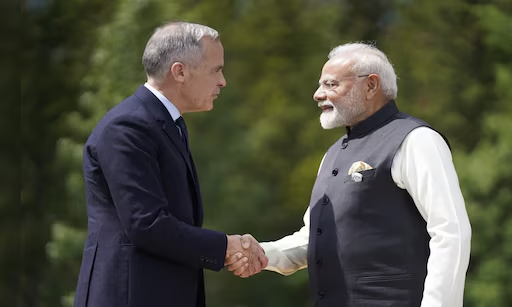
Canadian Prime Minister Mark Carney has begun his first official visit to India, a four-day tour scheduled from 27 February to 2 March 2026 at the invitation of Prime Minister Narendra Modi. The high-profile visit is being seen as a key opportunity to reset India–Canada relations after a turbulent phase and to inject fresh momentum into cooperation on trade, investment, clean energy and technology.
Carney lands in Mumbai on 27 February before travelling to New Delhi for delegation-level talks with Prime Minister Modi on 2 March at Hyderabad House, where both sides will review the India–Canada Strategic Partnership and draw up a forward-looking roadmap. Diplomats on both sides describe the visit as a carefully crafted attempt to turn the page and focus on areas where the two democracies can work together, from critical minerals and climate action to education and innovation.
Busy Mumbai Leg Focused On Business
According to the schedule released by Indias Ministry of External Affairs (MEA), Carney arrives in Mumbai on 27 February, where he will spend two full days in back-to-back business engagements. He is expected to interact with top Indian and Canadian CEOs, industry and financial sector leaders, innovators, academics and representatives of major Canadian pension funds that have already built sizable portfolios in India.
The Mumbai leg is designed to send a clear signal that both governments want to anchor the political reset in strong economic outcomes, particularly in sectors such as clean energy, infrastructure financing, digital innovation and sustainable urban development. Officials say the Canadian side is keen to highlight Canadas strengths in green finance and energy transition, while India is expected to pitch its rapidly growing market, manufacturing ambitions and reform trajectory to long-term Canadian investors.
Key Delhi Talks With Prime Minister Modi
After wrapping up meetings in Mumbai, Carney is scheduled to reach New Delhi on 1 March, ahead of formal talks at Hyderabad House on 2 March. The two leaders will hold delegation-level discussions, followed by the exchange of memoranda of understanding (MoUs) and joint press statements, according to the MEA advisory.
The agenda covers a wide canvas: trade and investment, energy and critical minerals, agriculture and food security, education and research partnerships, innovation ecosystems and people-to-people ties anchored in a vibrant Indian diaspora in Canada. Both sides are also expected to review progress on reviving talks for a Comprehensive Economic Partnership Agreement (CEPA) and to explore new mechanisms for facilitating smoother business and student mobility.
Prime Minister Modi and Carney will also jointly attend a session of the IndiaCanada CEOs Forum later in the day, bringing together corporate leaders from both countries to identify concrete projects and investment opportunities. The forum is being positioned as a bridge between policy announcements and on-ground deals, especially in sectors like clean technologies, digital public infrastructure, agri-tech and smart logistics.
Rebooting Ties After A Difficult Phase
Carneys visit comes after a period of deep diplomatic strain that followed allegations made in 2023 by the previous Canadian government over the killing of Khalistani separatist Hardeep Singh Nijjar, which India strongly rejected. The episode led to a sharp downturn in ties, including the expulsion of diplomats and a freeze on certain tracks of engagement, especially in trade negotiations and security cooperation.
Since taking office, Carney has signalled a desire to stabilise and normalise relations, focusing on shared economic interests and long-term strategic convergences rather than contentious issues. New Delhi too has underlined that it is ready to work with Ottawa on the basis of mutual respect for each others security concerns and sensitivities, while leveraging the potential of people-to-people and business linkages.
Officials describe the current moment as a reset window in which both governments can rebuild trust step by step, provided red lines are clearly understood and not crossed. The timing of Carneys visit, with India emerging as one of the worlds fastest-growing major economies and Canada recalibrating its Indo-Pacific strategy, adds to the sense of opportunity on both sides.
Strategic Sectors On The Table
Trade and investment will sit at the core of the discussions, with India already ranking among Canadas top trading partners and both sides eyeing a sharp expansion in two-way flows in the coming years. Canadian pension funds, institutional investors and companies are looking closely at Indias infrastructure push, renewable energy targets and expanding digital economy as long-term opportunities.
Critical minerals such as uranium, potash and rare earths are another area where complementarities are evident, with Canadas resource base matching Indias growing demand for secure, diversified supplies. Cooperation in this domain could support Indias energy transition, electric mobility plans and advanced manufacturing, while offering Canada a reliable market and strategic partner in the Indo-Pacific.
Clean energy and climate action are expected to feature prominently, building on Canadas expertise in green technologies and Indias commitments under its updated climate targets and initiatives such as the International Solar Alliance. Education and research linkages, including student exchanges, joint degrees and collaborative innovation projects, will also be discussed, given the large number of Indian students and professionals who choose Canada for higher education and work opportunities.
Regional And Global Context
Beyond bilateral themes, Modi and Carney are expected to exchange views on key regional and global developments, including the Indo-Pacific security environment, ongoing conflicts and the future of multilateral institutions. Both countries have highlighted the importance of a free, open and rules-based international order, even as they sometimes differ in their tactical approaches on specific issues.
Observers say the talks will test how far India and Canada can converge on strategic questions while managing differences, particularly on diaspora politics and human rights narratives. Any joint messaging that emerges from the visit is likely to emphasise cooperation on global challenges such as climate change, food and energy security and resilient supply chains.
What This Means For Indian Stakeholders
For Indian businesses, the visit signals that channels with Canadian capital and technology partners are reopening, potentially creating room for new joint ventures and long-term financing in sectors from renewables to fintech. State governments and city administrations that are actively seeking foreign investment may also look to pitch projects to Canadian pension funds and companies watching the visit closely.
Indian students and professionals in Canada will be tracking how both sides address mobility, visa facilitation and campus safety concerns, which have sometimes been caught up in larger political tensions. A more stable and predictable relationship could ease uncertainties for families that straddle both countries, particularly in major source regions such as Punjab and other northern states.
For strategic watchers, the visit will be an indicator of how quickly India and Canada can move from crisis management to a more mature, interest-driven partnership. The tone of the joint statements, the nature of the agreements announced and follow-through on economic initiatives will be closely scrutinised in the weeks after Carney returns to Ottawa.