

State Correspondents Special Report | Srinagar, Aug 2025
Accelerating climate change and steep temperature surges across high-altitude Himalayan ranges pose severe risks to the glaciers, seasonal snowfields, and downstream water security of Jammu and Kashmir, according to a landmark scientific study.
The comprehensive assessment, based on long-term climate observations spanning from 1901 to 2020 and cutting-edge global climate simulations, projects intense warming across the Greater Himalayas and Trans-Himalayan belts by the close of the century. The resulting rapid glacier retreat threatens to destabilize river hydrology, jeopardize drinking water, impact agriculture, and compromise hydroelectric power generation across Jammu and Kashmir.
High-Emission Trajectories Spell Cryospheric Disruption
To map past trends and future cryospheric shifts, researchers analyzed observational datasets from the Climatic Research Unit (CRU) alongside state-of-the-art Coupled Model Intercomparison Project Phase 6 (CMIP6) models.
The analysis reveals a steady, persistent increase in mean annual temperatures across the Himalayan region since the early 20th century. Under high-emission greenhouse gas trajectories, the study projects:
- Elevated Surface Warming: Pronounced warming concentrated at extreme elevations across the Greater Himalayan and Trans-Himalayan ridgelines.
- Depleted Snow Cover: Sharp declines in winter snowpack and shifts in precipitation patterns from snow to rain.
- Altered Hydrological Regimes: Early seasonal meltwater surges followed by prolonged low-flow periods, directly threatening river systems fed by mountain glaciers.
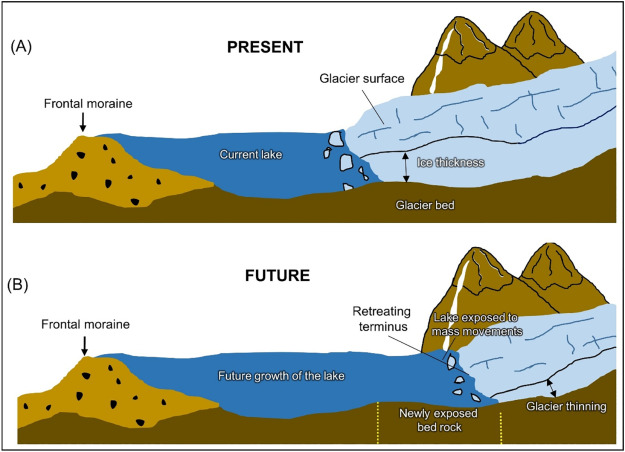
Growing Threats: Glacial Lake Outburst Floods (GLOFs)
Beyond long-term water scarcity, the study sounds an alarm on catastrophic short-term hazards, specifically Glacial Lake Outburst Floods (GLOFs).
As glaciers retreat, meltwater pools behind fragile, unstable moraines. When these natural dams fail due to avalanches, earthquakes, or hydrostatic pressure, immense volumes of water surge downstream without warning. While the eastern Himalayas have historically faced the bulk of GLOF events, researchers caution that warming temperatures are shifting GLOF vulnerabilities westward into Jammu, Kashmir, and Ladakh.
Key Recommendations from Researchers
The study—authored by Protyusha Mukhopadhyay, T. P. Sabin, Swagata Payra, Akhouri Pramod Krishna, and Parthasarathi Mukhopadhyay—underlines that the Himalayas contain over 15,000 glaciers supplying vital freshwater to hundreds of millions across South Asia.
To mitigate emerging risks for Jammu and Kashmir, the authors call for immediate institutional action:
- Dense Climate Monitoring Networks: Expanding high-altitude automated weather stations (AWS) to monitor localized microclimates.
- Hybrid Cryosphere Tracking: Combining ground-based hydrological monitoring with high-resolution satellite remote sensing to track ice thickness and lake volume changes.
- Early-Warning Systems: Deploying sensor-based real-time warning infrastructure along high-risk glacial lakes and river basins.
- Emission Cuts & Adaptation Planning: Integrating mountain-specific disaster preparedness and climate adaptation frameworks into regional infrastructure and water management policies.