




World Inequality Report 2026 Rekindles Debate On Whether India’s Growth Is Truly Inclusive
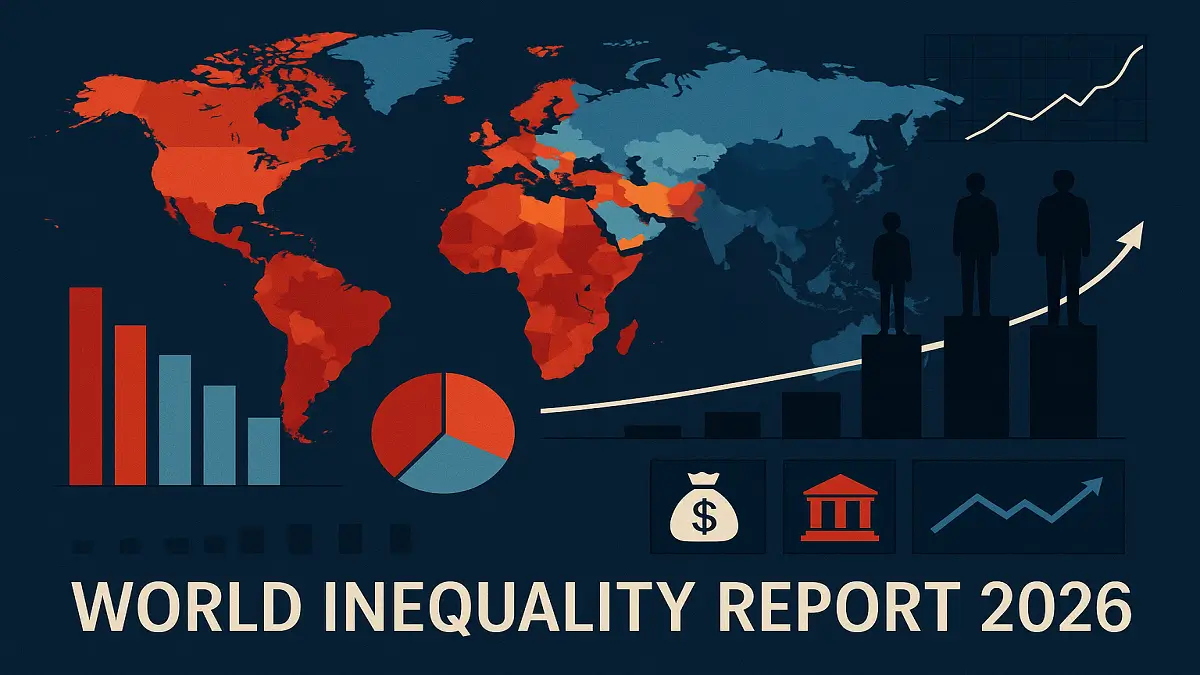
The third edition of the World Inequality Report, released for 2026 by the World Inequality Lab, has reignited a fierce debate on whether India’s growth story has been inclusive or has mainly enriched those at the very top. The study finds that income and wealth in India are now concentrated at levels comparable to the colonial era, even as official data continue to celebrate the country as one of the world’s fastest‑growing major economies.
Key Numbers: Top 10% Take 58% Of Income
According to the report, the richest 10% of Indians capture about 58% of total national income, while the bottom 50% share just 15%, leaving the middle 40% squeezed between stagnating wages and rising costs. Wealth gaps are even starker: the top 10% own roughly 65% of all household wealth, and the richest 1% alone hold around 40%, making India one of the most unequal large economies in the world.
In per‑capita terms, the average annual income is estimated at about €6,200 (roughly 6,984 US dollars in purchasing‑power terms), while average wealth per adult stands at around €28,000, figures that remain modest compared to advanced economies despite rapid GDP growth. The authors argue that these averages conceal deep internal divides, with a small elite enjoying global‑level incomes and assets and a vast population stuck at low or precarious earning levels.
Gender And Social Dimensions Of The Gap
Beyond pure income and wealth numbers, the World Inequality Report 2026 highlights persistently low female labour‑income shares in India, estimating that women account for only around 16–18% of total labour earnings. Female labour‑force participation remains stuck near 15–16%, with little improvement over the past decade, pointing to entrenched barriers in access to paid work, higher education and formal‑sector jobs.
The report also flags regional and social disparities, noting that rural bottom‑50% incomes have barely risen in real terms compared to urban upper‑tier earnings, and that Scheduled Castes and Scheduled Tribes are heavily over‑represented in the lower income and wealth brackets. Analysts say these patterns suggest that inequality in India is not only economic but also strongly linked to geography, caste, gender and access to quality education and health.
Why Inequality Is Rising Despite Growth
Researchers attribute the widening gap to multiple structural factors, including technology and financial‑sector–led growth favouring skilled urban workers, rising corporate concentration, weak labour protections and a relatively low tax‑to‑GDP ratio that limits redistribution. While the economy has created high‑productivity jobs in services and industry, real wages for the bottom 60% have either stagnated or grown slowly, and informal work continues to dominate large parts of the labour market.
The report also criticises the way taxation works at the very top, arguing that ultra‑rich individuals often face lower effective tax rates than the upper‑middle class because of loopholes, lighter taxation of capital gains and minimal wealth or inheritance taxes. Globally, it points out that the richest 10% are responsible for a disproportionate share of carbon emissions, adding an environmental dimension to debates on fairness and responsibility.
Policy Prescriptions And Political Reactions
To reverse these trends, the World Inequality Report 2026 recommends a combination of progressive income and wealth taxation, revival of inheritance duties on large estates, and global cooperation to curb tax evasion and profit‑shifting by multinationals. It also calls for massive investment in “universal public services” such as free quality schooling, healthcare, nutrition, childcare and social housing to narrow early‑life gaps and improve mobility for poorer households.
In India, opposition parties and several economists have seized on the findings to question whether recent growth, tax cuts and privatisation drives have disproportionately favoured big business and high‑net‑worth individuals. Government supporters counter that welfare schemes, direct benefit transfers, rural employment programmes and infrastructure spending have lifted millions out of poverty, arguing that the report underplays improvements in basic services and long‑term opportunities.
With inequality now back at the centre of public discourse, the report is expected to sharpen upcoming debates over budget priorities, tax reform and the balance between headline GDP growth and genuinely inclusive development ahead of 2030.