

By State Correspondents Bureau Dateline: New Delhi / Jammu Published: September 03, 2026 Reading Time: 3 Mins
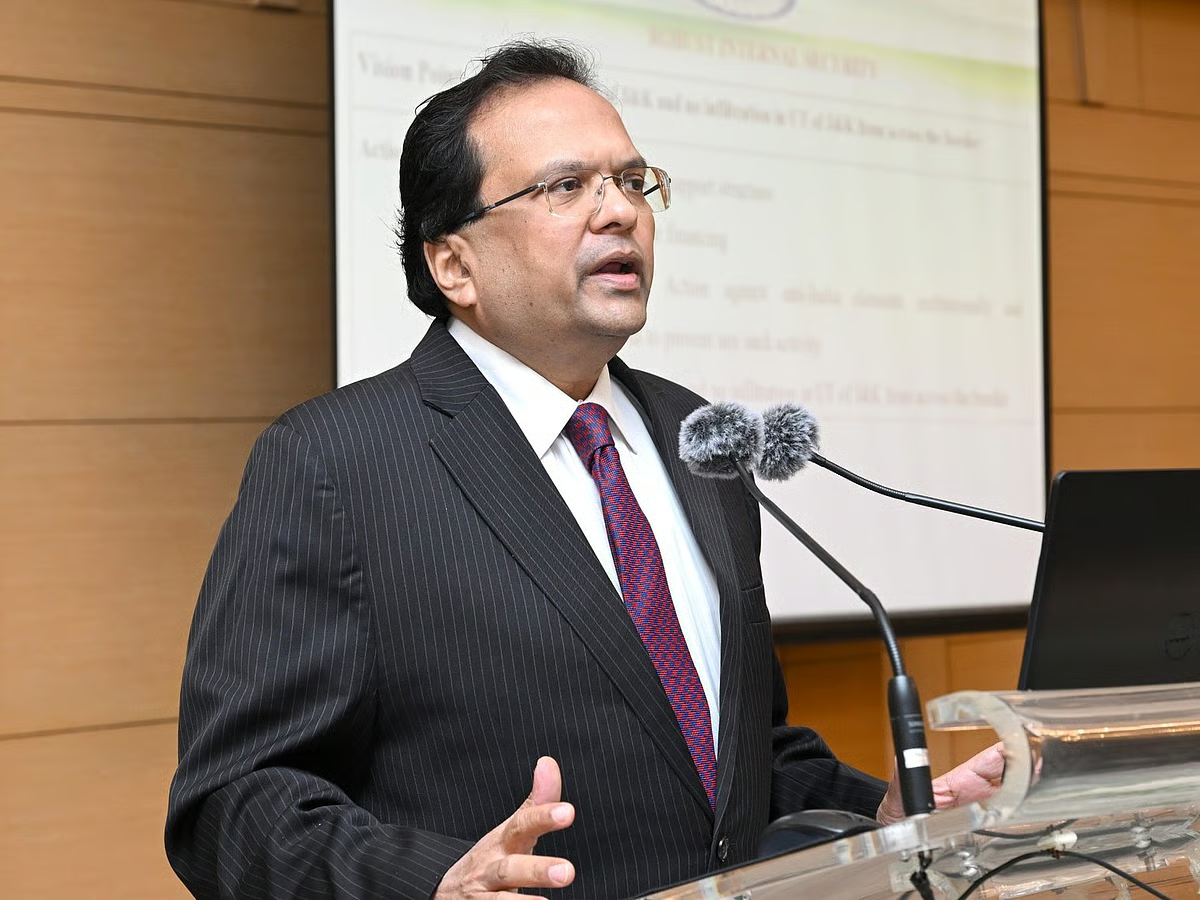
NEW DELHI: Confronting the severe climate and geomorphological hazards threatening fragile high-altitude ecosystems, Union Home Secretary Shri Govind Mohan on Thursday chaired an intensive national review session to safeguard five key Himalayan States and Union Territories against destructive Glacial Lake Outburst Floods (GLOFs) and treacherous snow avalanches.
The strategic deliberations held in the national capital brought together Chief Secretaries and executive teams from State Disaster Management Authorities (SDMAs) representing Jammu & Kashmir, Uttarakhand, Himachal Pradesh, Sikkim, and Arunachal Pradesh. Leading technical and scientific bodies—including the National Disaster Management Authority (NDMA), Central Water Commission (CWC), India Meteorological Department (IMD), and the Defence Geoinformatics Research Establishment (DGRE)—joined the Ministry of Home Affairs (MHA) to devise an impenetrable early-action shield.
Shifting Focus: Preventive Risk Reduction Over Post-Disaster Reaction
The review comprehensively addressed the shifting dynamics of glacial stability in the upper Himalayas, placing razor-sharp attention on end-to-end monitoring networks, predictive tracking of fragile water bodies, and detailed flood-route mapping. The Union Home Secretary stated unequivocally that regional administrations must break away from traditional post-event emergency handling, actively pivoting toward risk-informed territorial development and preventative protection.
Participating States and Union Territories laid out their on-ground mitigation matrices. These encompass automated real-time sensor networks over unstable glacial water accumulations, advanced avalanche prediction telemetry, and rapid dissemination channels ensuring urgent alerts reliably penetrate vulnerable downstream habitations before catastrophic flow paths breach riverbanks.
“Disaster preparedness across our high-altitude valleys must graduate completely beyond reactive relief work. We require rigorous scientific planning, preventative engineering interventions, and uncompromising community-level alert readiness before nature strikes.”
Fast-Tracking Central Mitigation Projects & Last-Mile Connectivity
A cornerstone directive issued during the review focused on speeding up the ground implementation of the dedicated GLOF mitigation programme sanctioned by the Union Government in 2024. The Home Secretary exhorted administrative leaderships to immediately review readiness blueprints, rectify bottlenecks in municipal and district early warning dissemination systems, and enforce proactive evacuation regimens.
Key Action Directives Issued to Himalayan Regions
- Dynamic Surveillance: Round-the-clock remote and physical monitoring of unstable glacial moraines and critical avalanche chutes during risk-prone climatic cycles.
- Integrated Data Sharing: Uninterrupted coordination pipelines linking scientific monitors (DGRE, IMD, CWC) with on-ground district emergency operation rooms.
- Expedited Execution: Accelerating field delivery under the Centre’s dedicated 2024 GLOF mitigation framework.
- Community Empowerment: Standardised local mock drills, safe sanctuary identification, and village-level emergency responder readiness.
Building an Resilient Shield for Vulnerable Valleys
The Union Home Secretary stressed that warnings issued by apex scientific institutions like the DGRE and IMD hold value only if actionable local responses are enacted instantaneously at the block and panchayat levels. The session culminated with firm instructions mandating continued inter-agency cooperation, continuous updates to digital risk registers, and reinforced emergency asset deployment across high-risk Himalayan belts to eliminate avoidable casualties and prevent severe loss of infrastructure.
© 2026 State Correspondents. All Rights Reserved.