

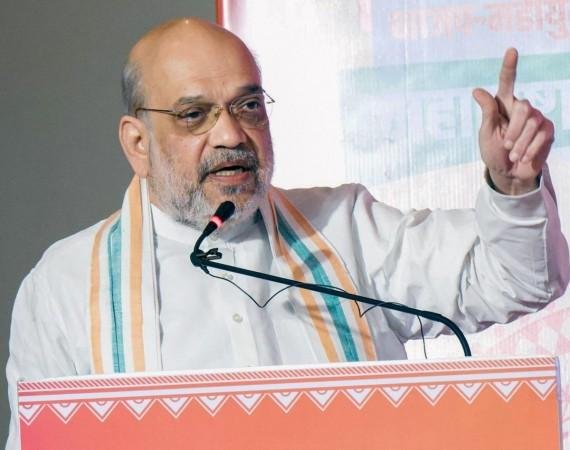
Under PM Modi, India Moved From Condemnation to Decisive Action Against Terrorism: Amit Shah
Union Home Minister emphasizes that abrogation of Article 370, surgical strikes, Balakot air strikes, and Operation Sindoor demonstrate India’s uncompromising ground doctrine of zero tolerance.
Key Policy Benchmarks & Takeaways
- ✓ Ground Zero-Tolerance: Transition from diplomatic condemnation to decisive kinetic retaliation.
- ✓ Constitutional Integration: Abrogation of Article 370 and complete reorganisation of J&K.
- ✓ Strategic Cross-Border Precedents: 2016 Surgical Strikes and 2019 Balakot Aerial Strikes.
- ✓ Operation Sindoor (2025): Firm counter-terror response following the Pahalgam incident.
- ✓ Internal Pacification: Decimation of left-wing extremism and historic peace pacts in the Northeast.
- ✓ Security-Led Prosperity: National security positioned as an essential pillar for economic growth.
Stating that India under Prime Minister Narendra Modi’s leadership has fundamentally moved beyond routine diplomatic condemnation of terrorism and external security challenges, Union Home Minister Amit Shah on Thursday declared that the country’s defense and counter-terror paradigm has undergone an unprecedented transformation over the last decade.
Highlighting the tangible shifts in national security doctrines, the Home Minister asserted that the administration’s stated policy of “zero tolerance” towards cross-border terrorism is not merely rhetoric, but has been executed with resolute precision on the ground.
“Abrogation of Article 370, the 2016 surgical strikes, the 2019 Balakot air strikes and Operation Sindoor in 2025 demonstrated India’s willingness to respond decisively to terror attacks. Under the leadership of Modi ji, the country has witnessed for the first time the policy of ‘zero tolerance’ against terrorism being implemented on the ground.”
Pertinently, the Union Government revoked the special constitutional status of Jammu and Kashmir under Article 370 on August 5, 2019, bifurcating and reorganising the erstwhile state into two Union Territories—Jammu & Kashmir and Ladakh. The strategic move paved the way for the full extension of the Indian Constitution, strengthening operational frameworks for national intelligence and unified law enforcement across the Union Territory.
Key Milestones: India’s Shift to Decisive Deterrence
Line of Control Surgical Strikes
Indian Army commandos penetrated terror launchpads across the Line of Control in retaliation to the Uri brigade camp assault.
Balakot Pre-Emptive Aerial Strikes
Indian Air Force fighter jets struck deep into Khyber Pakhtunkhwa to obliterate Jaish-e-Mohammed’s main operational training hub following Pulwama.
Article 370 Abrogation & Reorganisation
Revocation of special provisions, closing constitutional ambiguities and establishing direct federal counter-terror operational oversight.
Operation Sindoor
Targeted counter-action launched by Indian forces following the Pahalgam terror strike, underscoring an uncompromising deterrence policy.
Beyond cross-border actions, Amit Shah underscored the administration’s sweeping records in stabilizing domestic hotbeds and securing frontiers. He pointed out that long-festering internal conflicts and insurgencies in various pockets of the country have been resolved decisively through comprehensive security campaigns and political settlements.
“Naxalism has been eradicated, decades-old disputes in the Northeast have been resolved through peace accords, and the borders are secure.”
— Union Home Minister Amit ShahThe Home Minister firmly maintained that national security forms the bedrock of sustainable holistic development, emphasizing that economic stability and civil peace cannot flourish in an atmosphere vulnerable to external intimidation.
“A secure India is the first prerequisite for a prosperous India; Modi ji has proven this,” Shah stated.
‘Nation First’ Guiding Principle: BJP President Nitin Nabin
Concurrently, BJP President Nitin Nabin lauded Prime Minister Narendra Modi’s political journey, stating that the head of government’s strategic philosophy has consistently revolved around the doctrine of “Nation First.”
Nabin noted that the Prime Minister’s steadfast leadership has fostered domestic self-reliance (Atmanirbharta), bolstered national security infrastructure, and decisively elevated India’s geopolitical standing on the world stage. He characterized the last decade as an era marked by robust governance, institutional transparency, and massive public welfare initiatives.
According to Nabin, this governance trajectory has endowed the Indian republic with a “renewed identity and enhanced strength,” ensuring that future security challenges will be met with immediate resolve rather than diplomatic passivity.