

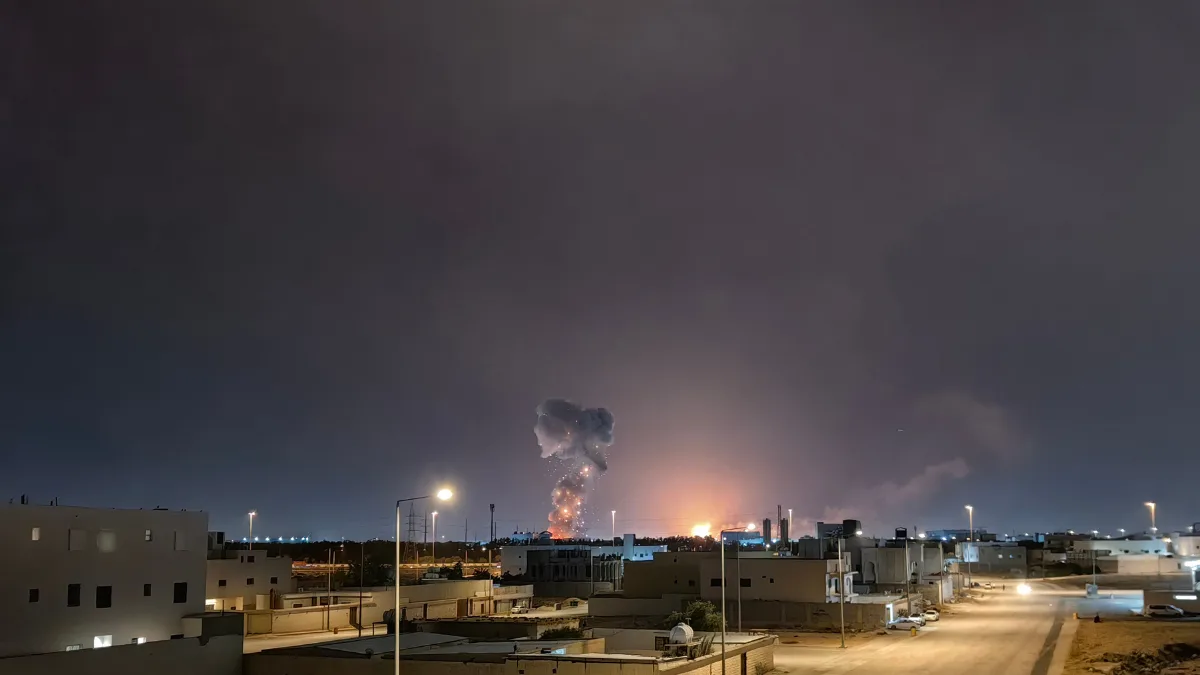
Middle East on the Brink: Coordinated Drone and Missile Attacks Strike Critical Saudi Industrial and Transport Hubs
RIYADH / DUBAI: Regional stability across West Asia fractured further on Tuesday as a synchronized wave of one-way attack drones and precision cruise missiles targeted key industrial corridors, petrochemical refining installations, and multimodal transport links across Saudi Arabia. The aerial incursions, launched across multiple operational vectors, triggered intense engagements by Saudi air defense batteries, with Patriot and counter-unmanned aerial systems (C-UAS) units firing continuously over coastal industrial hubs and desert transport arteries.
While the Royal Saudi Air Defense Forces confirmed the interception of the majority of incoming projectiles, falling shrapnel and secondary debris sparked contained fires near logistical staging terminals in the Eastern Province and disrupted civil aviation approaches around major regional hubs. The brazen strikes mark the steepest escalation in attacks on Gulf infrastructure in months, immediately injecting renewed volatility into international energy markets and threatening fragile diplomatic de-escalation channels established in the region.
Crisis Snapshot: Points of Escalation
- Target Profile: Logistics distribution hubs, coastal refining perimeter buffers, and freight railway junctions in the Eastern and Western provinces.
- Air Defense Interceptions: Joint surface-to-air missile units shot down over a dozen loitering munitions and cruise missiles before they reached primary production plants.
- Global Energy Shock: Brent crude climbed over 3.8% within hours of the opening salvos, with maritime freight insurance rates jumping in regional sea lanes.
- Civil Transit Disruptions: Flight diversions and holding patterns imposed over major commercial airspace corridors as precaution against rogue aerial vectors.
Multi-Vector Barrage Tests Gulf Air Defense Shield
Preliminary tactical assessments indicate the barrage was meticulously orchestrated to oversaturate localized radar arrays. Low-flying unmanned aerial systems, utilizing terrain-masking waypoints, approached alongside faster cruise missiles. Loud explosions echoed across industrial centers as defensive interceptors engaged hostiles in mid-flight, illuminating the pre-dawn skies.
Saudi authorities reported that while containment protocols prevented catastrophic damage to core processing plants, localized fires broke out at ancillary supply warehouses and fuel distribution depots due to falling debris. Industrial fire brigades brought the flare-ups under control without reports of mass casualties. Nonetheless, the sophistication of the trajectory and electronic jamming accompanying the strike force suggests advanced operational planning aimed at exposing vulnerabilities in regional critical infrastructure.
“Targeting logistics channels and industrial lifelines is a deliberate calculated attempt to destabilize the global energy grid and rattle investor confidence across Gulf economies.” — Senior Diplomatic Envoy, Gulf Cooperation Council (GCC)
Global Energy Ripples and Supply Chain Alarms
The immediate fallout was felt across trading desks in London, Singapore, and New York. International benchmark Brent crude surged above key resistance levels, driven by speculative anxiety over potential supply chain bottlenecks in the Persian Gulf and Red Sea logistics nodes. Commercial maritime fleets navigating adjacent straits have been directed to maintain maximum security alert levels, with tanker operators bracing for elevated insurance war-risk premiums.
Supply chain analysts warned that even brief disruptions to secondary distribution infrastructure can have compounding downstream effects on petrochemical exports and regional shipping timelines. Saudi Aramco and industrial zone administrators enacted comprehensive business continuity safeguards, assuring global buyers that export commitments remain insulated through redundant reserve pipelines and deepwater offshore loading terminals.
| Sector / Domain | Immediate Impact | Strategic Outlook |
|---|---|---|
| Energy Markets | Brent crude surges +3.8%; futures rally sharply | Volatile trading contingent on retaliatory posture |
| Air & Rail Transport | Terminal freight rerouted; civil flights delayed | Stringent no-fly defense buffer zones enforced |
| Maritime Shipping | War-risk insurance premiums hiked for regional waters | Naval escorts and maritime surveillance expanded |
| Regional Diplomacy | Emergency GCC & international security summits convened | Bilateral normalization talks face severe diplomatic headwinds |
Regional Diplomatic Condemnation and Security Realignment
The attacks drew swift, unequivocal condemnation from international partners and regional allies. Arab League members, alongside European capitals and the United States, issued stern warnings against reckless provocations that jeopardize global commerce and civilian lives. Embassies across Riyadh urged their nationals to exercise heightened situational awareness, restrict non-essential movement near industrial perimeters, and strictly comply with civil defense directives.
Inside the Kingdom, senior defense officials convened high-level national security meetings to evaluate countermeasures and bolster layered defensive umbrellas around peripheral economic corridors. Military spokespersons reiterated the Kingdom’s sovereign prerogative to defend its territory, citizens, and critical economic infrastructure against hostile actors using all necessary measures under international law.
An Unforgiving Strategic Horizon
As forensic teams recover missile fragments and wreckage for technical analysis, the wider Middle East stands at another perilous juncture. The targeting of high-value transport and economic hubs strips away the illusion of localized conflict, exposing how interconnected energy infrastructure remains uniquely vulnerable to modern asymmetric warfare.
Whether this episode heralds an open, broader regional confrontation or triggers intensive backchannel mediation will depend heavily on the retaliatory choices made in the coming hours. For now, radar units remain locked on active scan, air corridors operate under vigilant surveillance, and the world watches anxiously as tensions in the Gulf threaten to ignite wider geopolitical tremors.