

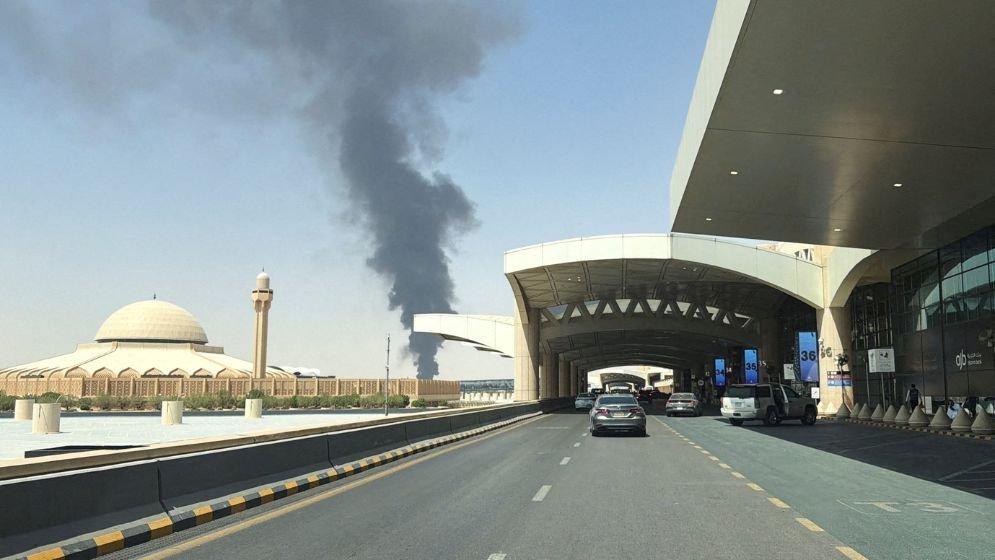
Flames and Plumes of Smoke Erupt Near Riyadh Airport Following Overnight Aerial Threat Alerts Across Saudi Capital
RIYADH: Massive pillars of black smoke and flames were seen billowing into the sky from the vicinity of King Khalid International Airport in the Saudi capital on Saturday, coming on the heels of urgent overnight security warnings issued by the Kingdom’s civil defence authorities regarding potential hostile aerial attacks.
The alerts, transmitted directly to mobile devices across Riyadh and the adjacent administrative district of Al-Kharj to the east, marked a major security alarm for the capital. The emergency broadcasts warned citizens to remain indoors and take precautionary measures against incoming hostile aerial vectors.
Key Developments at a Glance
- Aviation Chaos: FlightRadar24 logged its highest disruption index (level 5) at King Khalid International Airport, with major delays, diversions, and widespread cancellations.
- Emergency Alerts: Saudi Civil Defence sent midnight mobile broadcasts warning residents in Riyadh and Al-Kharj of imminent aerial threats.
- Visuals Near Terminals: Eyewitness video and photographs showed thick black smoke rising behind airport corridors, near apparent fuel storage installations.
- Regional Spillover: The alert follows escalated cross-border hostilities with Yemen’s Iran-aligned Houthi forces targeting Gulf infrastructure.
Smoke Plumes Near Key Energy and Airport Facilities
Visual documentation emerging from northern Riyadh showed a colossal column of thick smoke rising high into the atmosphere, visible over airport highways, auxiliary structures, and main passenger terminals. Flames were observed flickering near fuel depot infrastructure, with reports indicating that emergency firefighting units rushed to contain blazes affecting fuel tanks bearing the insignia of state oil corporation Saudi Aramco.
Residents across several neighborhoods of the capital reported hearing loud concussive thuds that rattled window frames prior to the emergence of the smoke plumes.
Flight Cancellations and Escalating Regional Tension
The aerial alert triggered immediate fallout on civil aviation. Real-time monitoring platforms, including FlightRadar24, placed King Khalid International Airport under severe operational distress, noting that inbound and outbound air traffic experienced cancellations, extensive holding patterns, and diversions to secondary airfields.
The alert underscores spiraling security friction across the Arabian Peninsula. In recent weeks, Yemen’s Houthi group has intensified long-range missile and drone deployments targeting southern and central Saudi installations following a declared naval and economic blockade. The renewed offensive has heightened global anxiety over commercial shipping routes through the Red Sea and broader critical energy supply corridors.
While the Saudi government media office has yet to issue an extensive formal statement detailing the precise interception tally or the exact trigger of the fuel depot blaze, regional air defenses remain on maximum alert across military corridors, vital logistical hubs, and major population centers.