
CM Omar Abdullah Challenges Centre: ‘Define What “Appropriate Time” Means for Statehood’
Defending the omission of Article 370 from the statehood resolution, the Chief Minister slams administrative hurdles, bureaucratic bottlenecks, and delays under the Union Territory setup.
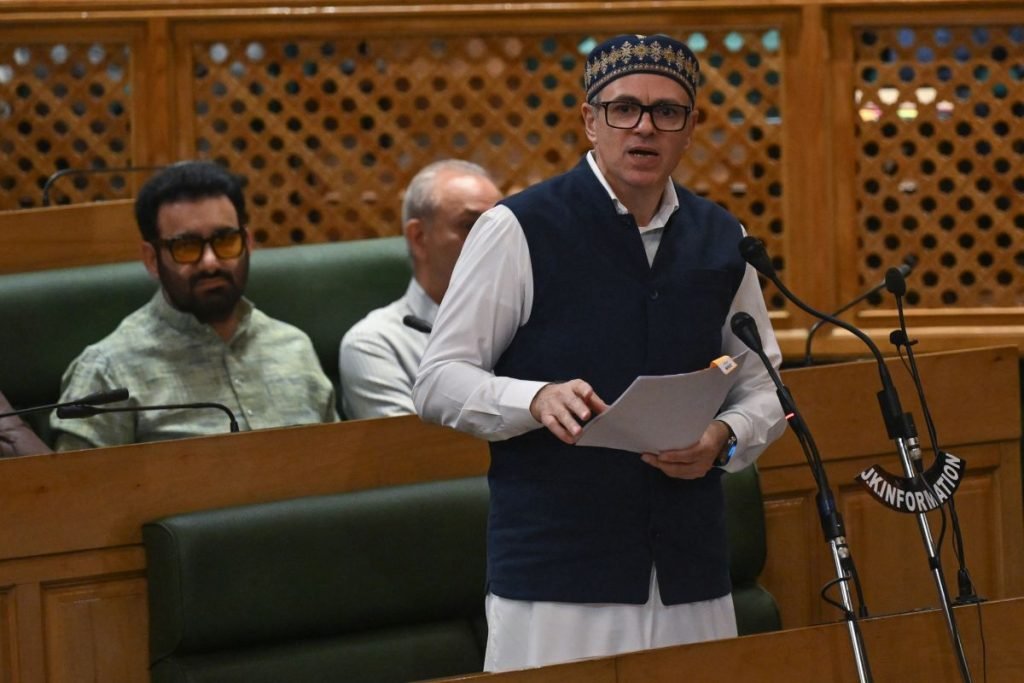
Mounting a sharp counter-offensive in the Legislative Assembly, Chief Minister Omar Abdullah on Monday urged the Central government to provide clarity on what it considers the “appropriate time” for restoring full statehood to Jammu and Kashmir, asserting that the people of the region have waited far too long for New Delhi to honour its solemn commitment.
Addressing the House while defending his government’s strategic decision to exclude references to Article 370 and 35A from the statehood resolution, the Chief Minister referred to the Apex Court’s observations, emphasizing that indefinite delay contradicts the spirit of the court’s stance.
Taking direct aim at arguments linking the grant of statehood with complete eradication of terrorism, the Chief Minister argued that such conditional narratives serve counterproductive ends.
Abdullah emphasized that Jammu and Kashmir has always recognized that the power to restore statehood rests with New Delhi, questioning why arbitrary conditions continue to be tied to the Centre’s solemn commitment. “If it has already been decided that the Prime Minister will not grant us statehood during his tenure, then it is a matter of profound regret,” he observed.
Key Takeaways From the CM’s Address
- Strategic Resolution Drafting: Article 370 and 35A were kept out intentionally to deny the BJP any pretext to disrupt or derail the motion.
- Terrorism & Statehood Link Rejected: Stated that linking statehood with terror incidents surrenders decision-making leverage.
- Administrative Crippling: Flagged pending Business Rules and absence of an Advocate General as consequences of the UT setup.
- Daily-Wagers’ Regularisation: Criticized delays by the committee, stating a full state government would have finalized it in four months.
Elaborating on why the resolution was focused squarely on statehood, Abdullah disclosed that it was drafted with extreme caution to prevent disruption. He noted that certain legislators had walked into a political trap by pushing amendments centered on special status.
“Read the resolution and tell me where we are asking for a vote on 370, 35A, or special status. When colleagues add 370 and 35A to it, they offer the opposition an opening to disrupt proceedings. We crafted this resolution so that nobody could be handed an excuse to stall the House,” he said, recalling that resolutions regarding special status had already been adopted twice before, including during Dr. Farooq Abdullah’s tenure in 2000.
Laying bare the bureaucratic obstacles confronting the elected administration under the Union Territory structure, the Chief Minister revealed that even regarding the statehood resolution, the Law Department had forwarded an opinion to the Speaker claiming the matter was sub judice—bypassing him entirely.
The Chief Minister further cited pending administrative files to illustrate the severe limitations of the UT framework, noting that the Union government has sat on the government’s Transaction of Business Rules for nearly two years without granting approval. Similarly, the appointment of an Advocate General has remained in limbo despite formal recommendations forwarded by the administration.
Turning his focus to BJP legislators demonstrating over the issue of daily-wage employees, Omar Abdullah slammed what he termed “superficial sympathy,” pointing out that the ongoing delay in their regularisation is itself a product of bureaucratic inertia fostered by the UT model.
“Those showing sympathy for daily-wagers today should answer one simple question: why has the committee tasked with examining their regularisation still failed to submit its report? They were given six months; it could have easily been resolved in four. Had Jammu and Kashmir been a full State, this process would never have dragged on for over a year,” Abdullah concluded.