




BJP’s Bengal Breakthrough: Massive 2026 Assembly Win Redraws West Bengal’s Political Map
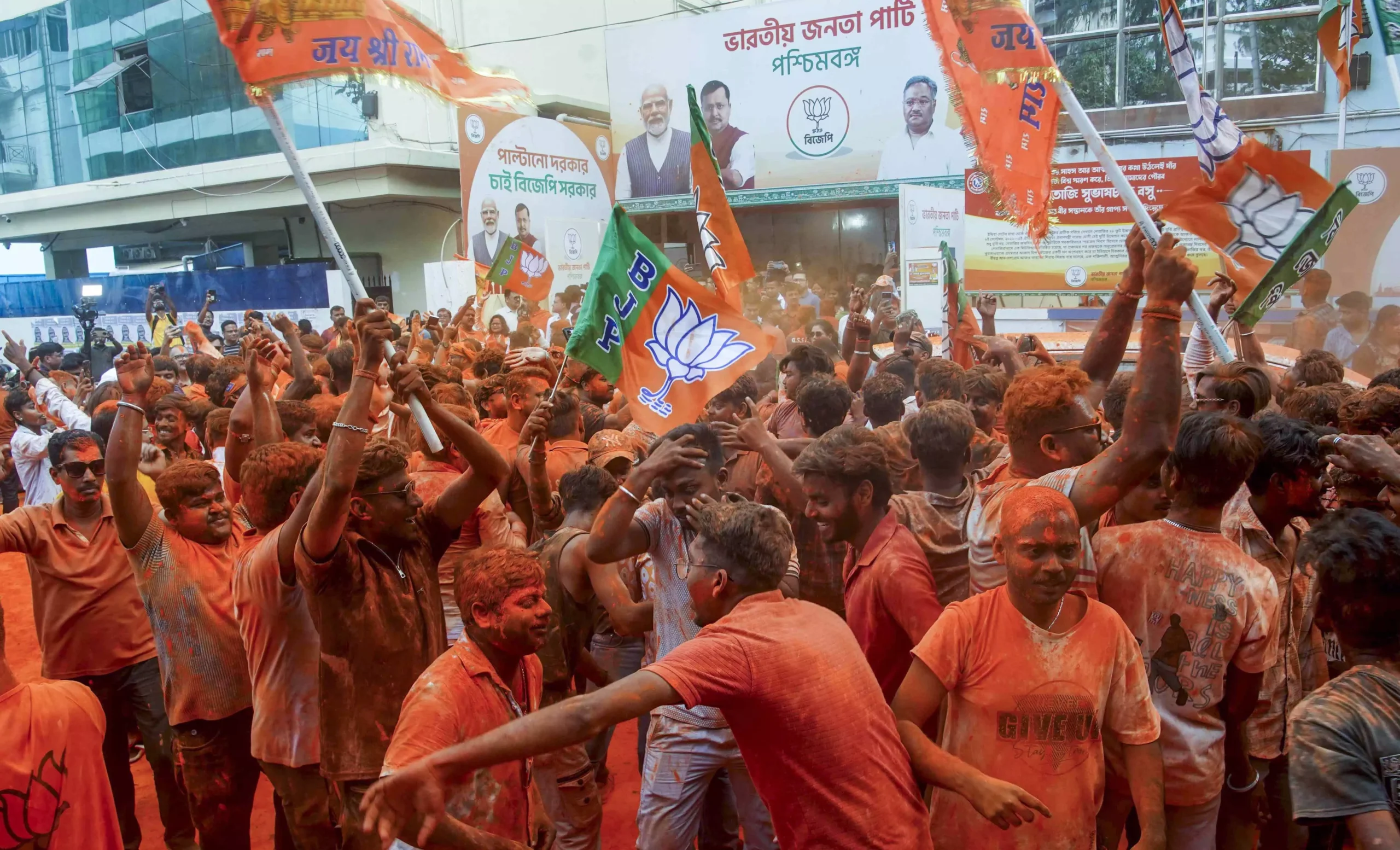
West Bengal has delivered one of the most striking verdicts of the 2026 election season, with the BJP crossing the majority threshold in the 294-member assembly and setting the stage for its first full-fledged government in the state. Early post-result reporting indicated that the BJP had surged beyond 200 seats in the 293 constituencies counted, while the Trinamool Congress fell far behind after more than a decade in power. For national politics, the message is unmistakable: Bengal, long considered one of the toughest political battlefields for the BJP, has now become the site of its most symbolic breakthrough in eastern India.
Seat Math That Defined the Verdict
The rank math of this election tells the real story. In a 294-seat assembly, any party needs 148 seats to command a majority. Reports on counting day showed the BJP not merely inching past that number but racing into dominant territory, with figures ranging from 204 seats won and leads in two more, to 206 seats already secured out of 293 declared constituencies. That kind of margin transformed the contest from a routine victory into a wave election.
For the Trinamool Congress, the reverse math was politically devastating. A party that once relied on organisational depth, regional charisma and welfare-driven mobilisation suddenly found itself trailing by a wide distance. When one side crosses 200 in Bengal, it is no longer just a government-changing result; it becomes a structural realignment of voter confidence. Such a performance suggests the BJP managed not only to consolidate its base but also to cut into voter segments that had stayed firmly with the ruling camp in previous cycles.
- Total assembly seats: 294
- Majority mark: 148
- BJP tally reported in major coverage: around 204 to 206 seats in declared results/trends
- Distance above majority mark: roughly 56 to 58 seats
- Political meaning: not a narrow win, but a commanding mandate
Why This Result Matters Beyond Bengal
This verdict matters because West Bengal has been one of India’s most politically charged states, where ideology, identity, welfare politics, cadre networks and street-level campaigning all intersect. The BJP’s rise here had been watched for years as a test of whether it could crack a deeply entrenched regional bastion. With this performance, the party appears to have done more than just grow; it has displaced the dominant force and rewritten the state’s power map.
For the national leadership, the win strengthens the BJP’s claim that its appeal extends beyond the Hindi heartland and traditional strongholds. For the opposition, Bengal’s result will raise difficult questions about alliance-building, leadership credibility and campaign strategy. A defeat of this scale in a high-profile state sends ripples well outside Kolkata, because it changes both perception and momentum ahead of future electoral contests.
Key Battles Intensified the Narrative
One of the most closely watched contests was in Bhowanipore, where reports said BJP leader Suvendu Adhikari defeated Mamata Banerjee by 15,105 votes. That outcome gave the result a powerful symbolic edge, because it was not only about seat totals but also about leadership prestige. A high-voltage state election often becomes memorable through signature contests, and this was the one that sharpened the national spotlight on Bengal’s changing mood.
The wider constituency trends added to the sense of momentum. India Today’s live coverage noted the BJP had won 204 seats and was leading in two more, while the Trinamool Congress had won 75 and was leading in six. Numbers of that scale created an unmistakable psychological effect on result day: what began as a competitive contest evolved into an expanding lead, and finally into a narrative of decisive transfer of power.
How BJP Built a Winning Arc
Every large victory rests on layers of political execution. The BJP’s Bengal campaign appears to have benefited from a strong central push, relentless booth-level attention, aggressive messaging around change, and the projection of a serious governing alternative. Once counting trends began to show that the party was performing not just in select pockets but across broad segments of the state, the election stopped looking like an upset and started resembling a well-engineered sweep.
The slogan of change carried extra force because it was backed by numbers. DD News reported that even earlier counting trends had placed the BJP far ahead of the TMC, signalling that the eventual result was not a late statistical fluke but part of a sustained lead. In electoral journalism, trends matter because they show whether a lead is fragile or systemic. Bengal’s 2026 verdict increasingly looked systemic.
What Comes Next: Government Formation and Leadership Questions
After a verdict of this size, the immediate attention shifts from counting tables to government formation. Hindustan Times reported that the BJP had won the West Bengal assembly polls for the first time and that names such as Suvendu Adhikari, Samik Bhattacharya and Agnimitra Paul were being discussed as possible chief ministerial contenders. That debate will now shape the second phase of the story: how the party converts a historic mandate into administrative control and public expectations into governance delivery.
The incoming government will face a dual challenge. First, it must stabilise the transition after a fiercely contested election and reassure all sections of society. Second, it must demonstrate that its Bengal campaign was not simply about defeating a rival, but about governing effectively in a state with complex social, economic and regional priorities. A landslide may grant political authority, but it also raises public expectations sharply.
What the Mandate Says About Bengal Voters
The electorate appears to have voted for a decisive shift rather than a fragmented verdict. When a party wins far above the majority mark, the message usually reflects both approval for the challenger and fatigue with the incumbent order. In Bengal, this interpretation will dominate political conversations in the coming weeks, especially because the result combines a seat sweep with a headline-grabbing leadership upset.
That said, the final historical significance of this election will depend on what follows. If the BJP turns its electoral momentum into a stable governing framework, the 2026 result will be remembered as the start of a long-term political era in Bengal. If it struggles with transition, internal leadership questions or delivery, the verdict may still remain historic, but for different reasons. For now, however, the raw fact stands above all analysis: Bengal has voted for a new power centre.
Fast Facts
BJP is reported to have crossed the majority mark and moved into government-formation territory in West Bengal for the first time.
Majority Formula
148 seats are needed in the 294-member assembly. Reported BJP tally: about 204-206 seats.
Headline Battle
Suvendu Adhikari was reported to have defeated Mamata Banerjee in Bhowanipore by over 15,000 votes.