




New Central Rules From April 2026: Tax, Public Services & Regulatory Changes Explained
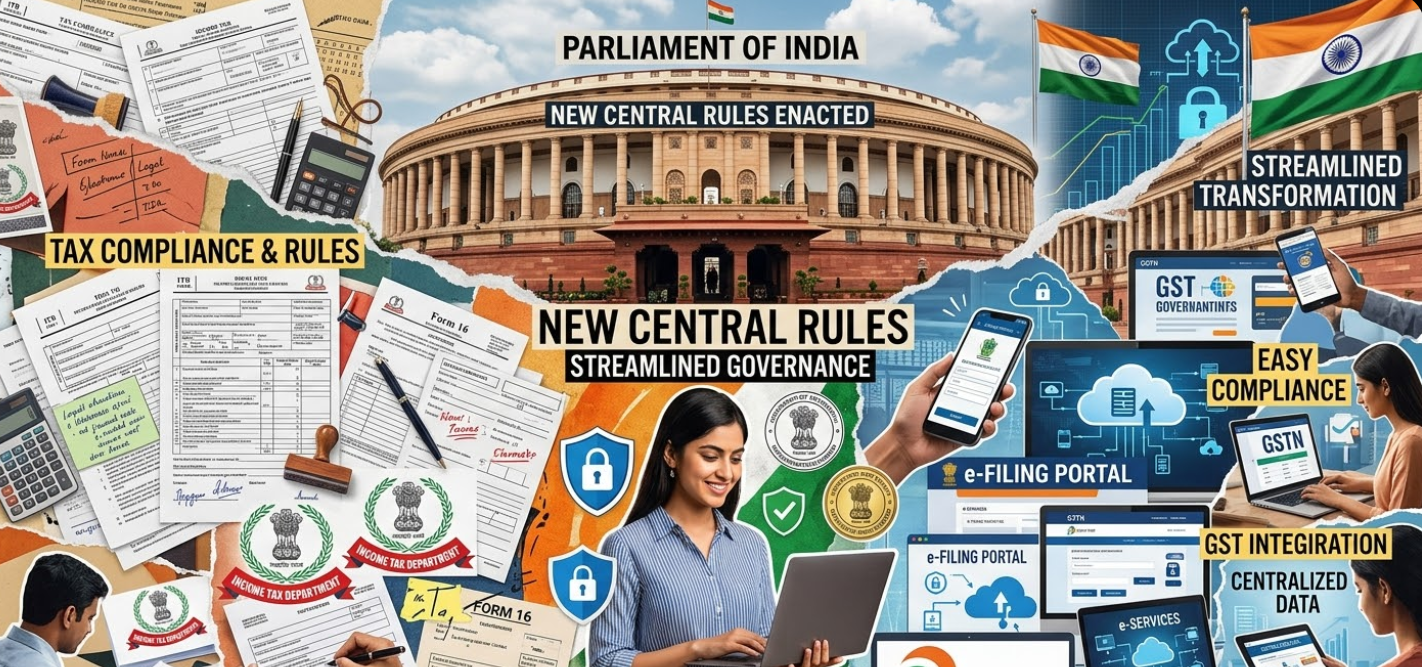
- A completely new Income Tax framework and fresh Income Tax Rules, 2026 kick in from 1 April 2026, promising simpler language, fewer rules and revised slabs.
- Budget 2026 overhauls TDS/TCS norms, revises timelines for returns and tightens high‑value transaction reporting under the new tax regime.
- Public‑facing rules include higher thresholds and risk‑based inspections for food businesses, updated digital‑banking and payment‑aggregator norms, and streamlined clinical‑trial approvals.
As India prepares to enter the new financial year 2026–27, central ministries and regulators are rolling out a cluster of fresh rules that will reshape how citizens pay tax, access public services and deal with banks, food businesses and even hospitals.
National media streams and official portals have started highlighting these changes, many of which take effect from 1 April 2026, while some guidelines are being notified in March itself so that taxpayers and businesses get time to adjust.
New Income Tax Act & Rules From April 1
At the heart of the 2026 changes is the rollout of a new Income Tax framework: the Income Tax Act 2025 becomes operational from 1 April 2026, replacing the 1961 Act, along with newly framed Income Tax Rules, 2026.
The Central Board of Direct Taxes (CBDT) has said the new rules are designed to widen the tax base while simplifying compliance—cutting the number of rules from more than 500 to a little over 300, using clearer drafting and removing outdated provisions.
Drafts were released for public feedback in February, and the final Income Tax Rules, 2026 are being notified in March so that taxpayers, professionals and software providers can re‑align systems before the new financial year starts.
New Slabs and Focus on ‘New Regime’
Under the new law and accompanying rules, the “new tax regime” is being further sweetened, with a higher basic exemption threshold and a larger band of tax‑free income for middle‑class earners, while retaining flexibility for those who still want to stay in the older exemption‑heavy regime.
Explanatory notes from tax portals and insurers highlight that the reworked slabs raise the zero‑tax band for individuals and moderate rates across subsequent income brackets, even as popular deductions like Section 80C and 80D continue under the legacy regime.
TDS/TCS Rule Overhaul & Compliance Timelines
Budget 2026 has also brought a major clean‑up of Tax Deducted at Source (TDS) and Tax Collected at Source (TCS) provisions, with multiple changes set to apply from 1 April 2026 across property deals, high‑value trade, overseas remittances and specific sectors like mining and scrap.
For instance, dedicated explainers point out that CBDT guidelines for TDS on property transactions and certain complex transfers will now be mandatory for all deductors, aiming to reduce disputes and ensure uniform practice nationwide.
New rationalised TCS rates are also being rolled out on items such as liquor, scrap, minerals and Liberalised Remittance Scheme (LRS) payments, while timelines for revising income‑tax returns are being extended to give taxpayers more breathing space to correct genuine errors.
Updated ITR Rules & CBDT’s Tech Push
CBDT has indicated that the new Income Tax Rules, 2026 will enable more centralised processing, deeper use of data analytics and technology‑driven scrutiny, with the goal of reducing manual, paper‑based interventions.
Official communication notes that by cutting and consolidating rules, the department wants to promote ease of doing business and make it easier to run fully digital, faceless processes wherever possible.
Commentaries on the Income Tax Bill 2026 add that CBDT has been given broader powers to issue binding circulars, design new compliance schemes and expand technology‑led risk‑based assessments, signaling a long‑term shift in tax governance style.
GST, Business Returns and Company Compliance
Parallel to income‑tax changes, Budget 2026 and subsequent circulars refine several indirect‑tax and corporate‑compliance requirements that start to bite from April 2026.
GST‑focused summaries highlight new due‑date calendars, updated formats for returns and a reinforced emphasis on reconciling figures across GSTR‑1, GSTR‑3B, input‑tax statements and income‑tax data to reduce mismatches.
Small businesses are being reminded of the March 31 deadline to opt for the GST composition scheme for FY 2026–27 and of fresh obligations to reconcile sales and tax data before entering the new financial year.
Food Safety: Higher Thresholds & Risk‑Based Inspections
Outside pure taxation, one of the most citizen‑facing rule changes comes from the Food Safety and Standards Authority of India (FSSAI), which has notified a major overhaul of licensing and inspection norms that kicks in from 1 April 2026.
A recent press release explains that the turnover threshold for mandatory central registration of food businesses is being raised sharply, with smaller players increasingly falling under state‑level regimes and only the largest entities needing central licences.
At the same time, FSSAI is rolling out a technology‑enabled, risk‑based inspection framework where inspection frequency depends on the nature of the food product, past compliance track record and third‑party audit results—aiming to reward compliant operators while focusing enforcement on genuine problem areas.
Banking & Digital Payments: RBI’s 2026 Playbook
In the financial‑services space, the Reserve Bank of India has lined up several regulatory changes that phase in through early 2026, affecting digital banking, basic savings accounts, payment aggregators and the next leg of the e‑rupee pilot.
Sector reports note that the consolidated digital‑banking directions notified in late 2025—covering internet and mobile banking across commercial and urban co‑operative banks—become fully effective in 2026, tightening consent norms, cyber‑security standards and board‑level responsibility for tech governance.
Revised master directions for payment aggregators, issued in 2025 and now entering their main compliance window, bring offline and cross‑border aggregators firmly into the regulatory net, with detailed rules on capital, merchant due diligence, settlement timelines, escrow management and data localisation.
Emerging Areas: Fintech, Stablecoins and Tokenised Assets
Commentaries on India’s 2026 regulatory priorities suggest that RBI and other regulators are also preparing clarifications on oversight of stablecoins, virtual‑asset intermediaries and tokenised financial instruments, depending on how the Centre finalises its crypto and digital‑asset policy.
NBFCs and digital‑lending platforms can expect tighter fit‑and‑proper norms and stronger conduct rules through 2026 as part of a broader risk‑management push.
Health & Pharma: Faster, Simpler Clinical‑Trial Rules
The Union Health Ministry has also notified amendments to the New Drugs and Clinical Trials (NDCT) Rules, 2019, with 2026 reforms aimed at speeding up approvals while relying more on risk‑proportionate oversight.
According to sectoral analyses, low‑risk, non‑commercial drug manufacturing for research will move from a test‑licence model to an online “prior‑intimation” system, letting companies start activity after notifying regulators digitally, while high‑risk categories like cytotoxics and narcotics remain under stricter licensing.
For many bioequivalence and bioavailability studies, prior permission requirements are being relaxed or replaced with online intimation, cutting processing timelines and aligning with India’s broader ease‑of‑doing‑business agenda.
What Citizens and Businesses Should Do in March–April 2026
Experts say March and April will be crucial “transition months” where individuals, CA firms and businesses must update their compliance playbooks to match the new rules going live from 1 April 2026.
For salaried taxpayers and small shopkeepers, that means checking how the new slabs and TDS/TCS tweaks affect take‑home pay, EMIs, rent agreements and high‑value purchases; for SMEs and corporates, it means aligning GST returns, revisiting contracts and upgrading ERP and billing systems.
Food businesses, online merchants, fintechs and pharma companies meanwhile need to map themselves against the new FSSAI, RBI and NDCT frameworks to avoid penalties and to take advantage of simplified, tech‑enabled approval and inspection processes.
Tags:
Like and Follow State Correspondents Facebook Page Latest International News Iran US War Subscribe for alerts© 2026 State Correspondents. All rights reserved.