




Bangladesh High Commission in Delhi Suspends Visa and Consular Services Amid Diplomatic Tensions
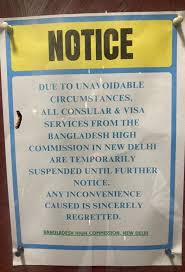
The Bangladesh High Commission in New Delhi has temporarily suspended all visa and consular services for Indians, a day after India shut down visa operations at its Chittagong Visa Application Centre citing security concerns, underscoring a sudden and serious chill in bilateral ties.
A notice pasted outside the mission in Chanakyapuri says that “due to unavoidable circumstances, all consular & visa services from the Bangladesh High Commission in New Delhi are temporarily suspended until further notice,” adding that any inconvenience caused is regretted. The decision comes amid rising political unrest in Bangladesh and growing anger over perceived Indian involvement, following the death of student and youth leader Sharif Osman Hadi last week.
- Bangladesh High Commission in Delhi has halted all visa and consular services for Indians until further notice.
- Move follows India’s suspension of visa services at its Chittagong Visa Application Centre over security fears after protests.
- Protests in both countries and death of youth leader Sharif Osman Hadi have pushed ties into a tense phase.
- Missions in Agartala and some private centres in Siliguri and Tripura have also stopped visa services.
What the Delhi mission has announced
The public notice by the Bangladesh High Commission, displayed at the main gate, clearly states that all consular activities, including issuance of visas, attestations and related services, are being suspended immediately “until further notice.” Officials in Dhaka’s Ministry of Foreign Affairs confirmed to local media that the step was taken in view of “unavoidable circumstances” and that a review would be undertaken before any decision on resumption.
Apart from New Delhi, the Assistant High Commission of Bangladesh in Agartala and some private visa processing facilities serving Siliguri and surrounding areas have also stopped accepting applications, affecting cross‑border movement on the eastern flank. The development is expected to hit business travellers, medical tourists, students and families with people‑to‑people links on both sides.
India’s earlier suspension in Chittagong
India had on Sunday indefinitely suspended visa operations at the Indian Visa Application Centre (IVAC) in Chittagong after a security incident and protests near the Assistant High Commission of India in the port city. The IVAC statement said services at the Chittagong centre would remain closed from December 21 “until further notice” and that reopening would be considered only after a review of the security situation.
Demonstrators, including students and local residents, had gathered outside the Indian mission in Chittagong’s Khulshi area to protest the killing of Sharif Osman Hadi, an outspoken critic of India who played a key role in the movement that toppled the Sheikh Hasina government. Police used force to disperse the crowd, leaving several people injured and prompting authorities to step up security around Indian diplomatic premises across Bangladesh.
Protests, threats and security concerns
On the Indian side, small but vocal protests have been held outside Bangladeshi missions, including by Hindu nationalist groups demanding justice and better protection for minorities in Bangladesh after recent attacks and killings. In one such incident, around 20–25 protesters gathered outside the Bangladesh High Commission in Delhi, triggering claims in Dhaka that the High Commissioner, Riaz Hamidullah, had received threats, though India’s Ministry of External Affairs has denied any security breach.
Indian officials say the Delhi protest was brief and peaceful, that police promptly pushed the crowd back and that security deployment around the mission has been strengthened in line with Vienna Convention obligations. However, Dhaka has treated these episodes, combined with unrest back home, as enough reason to pause consular outreach until it is satisfied that there is no immediate risk to its personnel or premises.
Strain in India–Bangladesh relationship
The tit‑for‑tat suspensions come at a time when a parliamentary committee in India has already flagged “generational disconnect” and potential strategic realignment in Bangladesh as key long‑term challenges for the relationship. Bangladesh has been in turmoil since the ouster of Sheikh Hasina, with new factions jostling for power and some groups openly mobilising opinion against India’s role in the neighbouring country’s politics.
India has summoned Bangladesh’s envoy Riaz Hamidullah to convey strong concern over extremist elements threatening protests around the Indian High Commission in Dhaka and other missions. New Delhi has also publicly rejected what it calls “false narratives” being spread about India’s involvement in internal events in Bangladesh, even as it insists that the safety of Bangladeshi diplomatic staff on Indian soil remains fully protected.
Impact on travellers and what happens next
For now, Indian citizens planning to travel to Bangladesh for tourism, work, studies or family visits from Delhi and parts of eastern India will have to defer their plans until either the High Commission or its outposts resume accepting visa applications. Similarly, Bangladeshis who depend on the Chittagong IVAC for Indian visas—especially businesspersons, students and patients headed to Indian hospitals—are also left in limbo.
Both sides have indicated that the suspensions are “temporary” and subject to periodic security reviews, leaving room for a calibrated rollback once street tensions subside and assurances are exchanged through diplomatic channels. Analysts say the immediate priority for Delhi and Dhaka will be to prevent further escalation, protect their missions and citizens, and compartmentalise these tensions so that long‑term trade and connectivity projects are not derailed.