

2,000-Year-Old Buddhist Site in Baramulla Adds Rich Chapter to J&K’s History: Chief Secretary Atal Dulloo
Second phase of excavation commences at Zehanpora; spot to be developed into a premier heritage tourism hub as scientific analysis of Kushan-era relics gets underway.
BARAMULLA: Chief Secretary Atal Dulloo characterized the ancient Buddhist settlement discovered at Zehanpora in North Kashmir’s Baramulla district as a remarkable historical treasure, stating that ongoing archaeological excavations are poised to unlock crucial insights into Jammu and Kashmir’s ancient civilizational heritage.
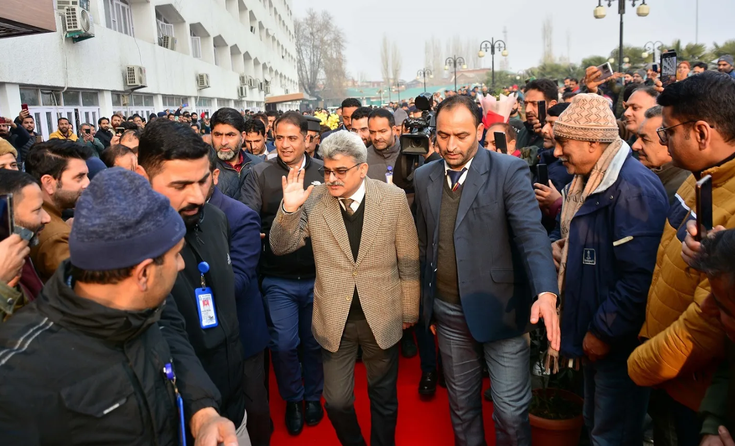
Interacting with reporters during his on-site inspection of the historical area, the Chief Secretary affirmed that the second phase of excavation has officially resumed following all statutory clearances, and further groundbreaking revelations are expected as the field investigation progresses.
“Initial evaluations establish that this is a 2,000-year-old Buddhist settlement. A more complete picture will emerge as the digging and mapping advance,” Dulloo stated, adding that the uncovering of structural remains, artifacts, and utilitarian objects will illuminate everyday life and cultural practices from two millennia ago.
- Chronological Era: Traced back to the 1st–2nd Century CE (Kushan Empire period).
- Discovered Features: Intact Buddhist stupas, monastic complexes, and structural remnants of an urban layout.
- Current Timeline: Active Phase-II digging mapped for 3 months; comprehensive multi-disciplinary analysis to span up to 5 years.
- Scientific Validation: Concurrent material testing, radiometric dating, and cataloging underway.
- Tourism Prospect: Earmarked for development as an international cultural and heritage circuit attraction.
“This excavation ensures a priceless cultural asset is added to our historical legacy. Moving forward, this archaeological treasure will be positioned as a major tourism attraction in the region.”
Five-Year Roadmap for Documentation & Scientific Dating
The initial groundwork at the Zehanpora site commenced in October last year before being temporarily paused for technical assessments. With Phase-II now underway, specialized field operations are scheduled to run over the next three months.
Dulloo noted that simultaneous scientific and laboratory testing of unearthed materials is in progress to authenticate their structural composition, precise antiquity, and contextual significance. While the current excavation cycle spans three months, the complete program—encompassing excavation, conservation, scientific dating, and archival documentation—is estimated to take up to five years.
National Spotlight on Kushan-Era Relics
The Zehanpora complex was first identified in 2025 during structured surface surveys and systematic archaeological exploration. Early investigations exposed well-preserved Buddhist stupas, residential monastic enclosures, and stone-and-brick foundations typical of Kushan-era urban design.
The discovery previously garnered national recognition, with Prime Minister Narendra Modi hailing the find as a proud milestone in documenting India’s deep spiritual and civilizational legacy. The UT administration is preparing a comprehensive conservation and tourist facilitation blueprint to integrate the site into Jammu and Kashmir’s broader heritage circuit.