



🔥 8th Pay Commission 2026: Game-Changer Salary Hike for 1 Crore Central Govt Employees! 💰
By State Correspondents News Desk | February 26, 2026
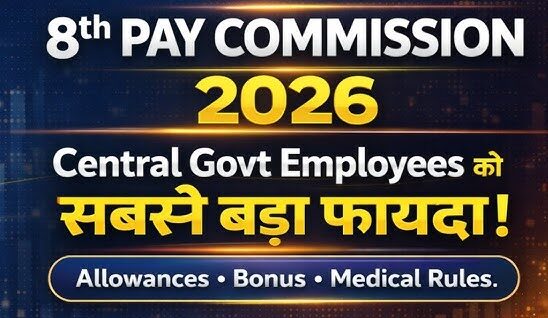
Visualizing the Anticipated Salary Surge: Central Government Employees Gear Up for 8th Pay Commission Benefits.
Introduction to the 8th Pay Revolution
The 8th Central Pay Commission (CPC), a beacon of hope for over 50 lakh central government employees and 65 lakh pensioners, is poised to redefine financial stability in India. Announced with fanfare in early 2025 and formally approved by the Union Cabinet, this commission promises substantial salary revisions effective from January 1, 2026. In the scenic valleys of Jammu & Kashmir, where state employees mirror central structures, the buzz is electric—could this mean doubled take-home pay for local educators, doctors, and administrators?
Chaired by former Supreme Court Judge Justice Ranjana Prakash Desai, the panel has an 18-month mandate to overhaul pay matrices, allowances, and pensions. With arrears likely from the notional date, millions await a windfall that could inject billions into the economy. State Correspondents delves deep into the latest developments, employee aspirations, and what this means for everyday Indians.
Key Milestones in 8th CPC Journey
-
>Jan 2025: In-principle Cabinet approval under PM Narendra Modi’s leadership.
>Oct 2025: Terms of Reference (ToR) cleared; chairperson and members notified.
>Nov 2025: Official constitution; 18-month report deadline set for May 2027.
>Jan 2026: Notional implementation date; interim relief demands peak.
>Feb 2026: Employee unions push for 3.25 fitment factor in key meetings.
Recent Rajya Sabha replies confirm the commission’s active functioning, with public consultations via MyGov closing March 16, 2026. In J&K, regional bodies echo national calls, urging inclusion of local governance staff.
8th Pay Commission 2026 Fitment Factor: The Heart of Salary Hike
The fitment factor— a multiplier on current basic pay— is the talk of the town. Unions demand 3.0-3.25, potentially raising minimum pay from ₹18,000 to ₹58,500+. Conservative estimates hover at 2.28-2.86, still a 128-186% jump. Driven by CPI inflation and DA trends, this factor will reshape the 33-level salary matrix.
Pro Tip for J&K Employees: A 2.86 factor could boost your basic pay by 40-50%, plus HRA revisions tailored to high-altitude postings!
8th Pay Commission 2026 Expected Salary Matrix Under 8th CPC
| Pay Level (7th CPC) | Current Basic Pay (₹) | Projected 8th CPC (2.86 Fitment) | % Increase |
|---|---|---|---|
| 1 (Entry) | 18,000 | 51,480 | 186% |
| 5 (Mid-Level) | 47,600 | 1,36,136 | 186% |
| 10 (Senior) | 1,00,900 | 2,87,574 | 186% |
| 18 (Top) | 2,50,000 | 7,15,000 | 186% |
Maximum salary could touch ₹4.86 lakh pre-allowances, with annual increments eyed at 7% from current 3%. Pensioners anticipate minimum ₹20,500+ monthly.
8th Pay Commission 2026 Employee Demands: Voices from the Ground
Central govt unions like CCGEW threaten strikes unless 20% interim relief is granted from Jan 2026. Other asks: Restore OPS over NPS, include GDS, scrap 5% compassionate appointment cap, and equal pay for contract workers. Postal bodies push 5% annual hikes and visible salary jumps.
-
>20% interim relief till full rollout.
>DA/DR instalments release; gratuity hike.
>No outsourcing; fill vacancies.
>Minimum pension ₹9,000+ for all.
In J&K, local reporters note heightened anticipation amid regional economic pressures, with calls for state-specific adjustments.
8th Pay Commission 2026 Pension and Allowance Reforms
Beyond salaries, the 8th CPC eyes pension parity—no distinction by retirement date. HRA, TA, medical benefits face overhaul, with tech-driven HR reforms promised. Assam’s parallel panel signals state-level ripples.
Arrears from Jan 1, 2026, are almost certain, boosting consumption in sectors like housing and autos.
Impact on Jammu & Kashmir Employees
For J&K’s 1 lakh+ central staff, this means empowered families amid tourism revival. Educators in remote areas, defense personnel, and pensioners stand to gain most. State Correspondents predicts a 30-50% disposable income rise, fueling local businesses.
Government’s Balancing Act
Fiscal prudence tempers hikes; expect outcome-based governance ties. Yet, with 1.2 crore beneficiaries, the economic multiplier effect is massive.