




Rajnath Singh Flags India’s Drone Power Push Amid Global Security Concerns
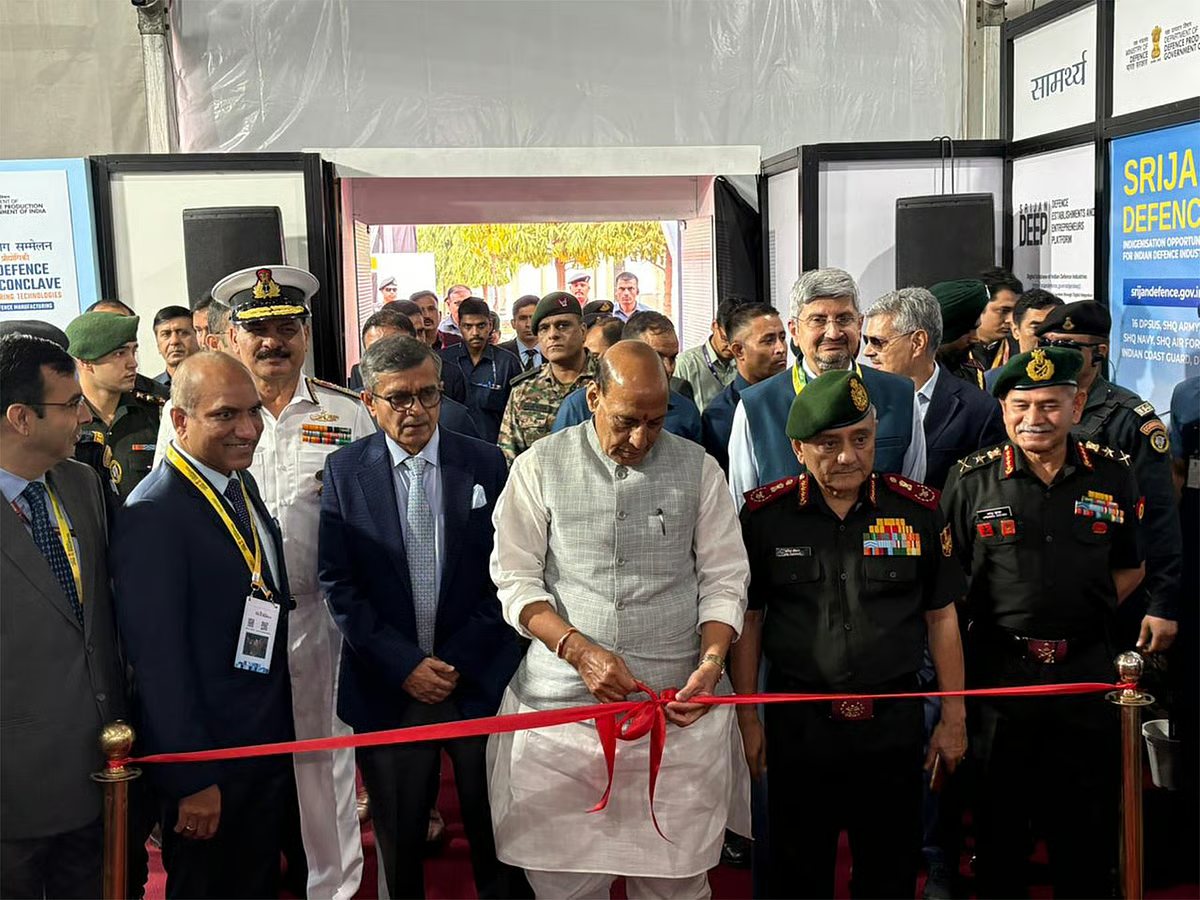
Against the backdrop of the West Asia war and ongoing conflicts such as Russia–Ukraine, Defence Minister Rajnath Singh has sounded a clear alarm on India’s need to rapidly scale up its drone power and shed dependence on foreign components. Addressing the National Defence Industries Conclave 2026 in New Delhi, he called for a mission-mode push to build a fully indigenous drone production ecosystem that can safeguard India’s strategic autonomy in an increasingly uncertain world.
Global Conflicts Put Drones at the Centre of Warfare
In his address, Rajnath Singh pointed out that the world is watching a new era of warfare play out in real time, with drones featuring heavily in theatres from Eastern Europe to West Asia. The Russia–Ukraine conflict and the confrontation between Iran and Israel have both demonstrated how unmanned aerial vehicles, loitering munitions and counter-drone systems can alter the battlefield by enabling precision strikes, surveillance and electronic warfare at relatively low cost.
The Defence Minister stressed that these examples serve as a warning for India to prepare for scenarios where adversaries might deploy swarms of drones, cheap explosive-laden UAVs and sophisticated surveillance platforms along sensitive borders. Building robust detection, tracking and neutralisation capabilities — through jamming, directed-energy weapons and kinetic interceptors — is now seen as central to India’s air defence posture.
At the same time, India is planning to employ drones more extensively for its own offensive and defensive missions, including long-endurance surveillance, maritime patrol, logistics support and precision targeting. This dual challenge of leveraging drones as a force multiplier while guarding against hostile platforms is pushing policymakers to view drones as a core pillar of national security rather than a niche technology.
Why Self-Reliance in Drone Components Has Become a Strategic Imperative
Rajnath Singh cautioned that global drone supply chains remain heavily dependent on Chinese-made components, ranging from flight controllers and communication modules to batteries and optical payloads. For a country like India, which faces sensitive border challenges and complex regional equations, such reliance is increasingly seen as a serious vulnerability.
He argued that self-reliance must go far beyond assembling imported kits or simply fabricating airframes domestically. Instead, India’s goal should be to indigenise the full stack: moulds and structures, propulsion systems, guidance and navigation software, encryption-heavy communication links, sensors, data-processing hardware and ground control systems.
Defence planners have already begun scrutinising the presence of foreign, especially Chinese-origin, parts in drones used along the northern and eastern borders. A recent case of an Army drone reportedly being compromised near the northern front due to imported autopilot hardware has reinforced concerns that critical vulnerabilities can be exploited through hidden backdoors in hardware or firmware.
Mission 2030: India’s Push to Be a Global Drone Hub
Laying out a timeline, Rajnath Singh said India must work in “mission mode” so that by 2030 the country emerges as a global hub for indigenous drone manufacturing. This would not only strengthen defence preparedness but also open up export opportunities in friendly markets looking to diversify away from a handful of dominant suppliers.
India has already approved major projects to acquire and co-develop medium-altitude long-endurance (MALE) drones for the armed forces, alongside smaller UAVs for tactical surveillance, perimeter security and precision engagement. A Vision 2047 roadmap unveiled by the defence establishment also talks about raising dedicated drone units and integrating unmanned systems deeply into tri-service operations.
According to officials, the path to Mission 2030 runs through strong collaboration between large defence public sector undertakings, private industry, MSMEs and deep-tech startups. The government is pitching India’s large talent pool in software, artificial intelligence, robotics and electronics as a natural advantage in this race.
iDEX, ADITI and DISC-14: Nurturing a Drone Innovation Ecosystem
At the Conclave, Rajnath Singh launched the 14th edition of the Defence India Start-up Challenge (DISC-14) and the fourth edition of ADITI (Acing Development of Innovative Technologies with iDEX) challenges under the Innovations for Defence Excellence (iDEX) framework. Together, these programmes are designed to funnel real operational problems from the armed forces and other defence agencies directly to innovators.
A total of 107 problem statements were unveiled across the Armed Forces, Indian Coast Guard and Defence Space Agency, many of them focused on unmanned systems, surveillance, autonomy, electronic warfare and simulation. Startups and MSMEs selected under iDEX receive funding, mentoring and access to test ranges so that promising prototypes can graduate into fieldable products.
Officials say that over forty procurement contracts worth more than ₹2,000 crore have already been signed under iDEX-linked initiatives, proving that the pipeline from innovation challenge to deployment is beginning to mature. For homegrown drone makers, these schemes offer a predictable path from laboratory ideas to large defence orders.
Balancing Drone Power with Strong Counter-Drone Defences
Even as India expands its own fleet of surveillance and attack drones, the defence establishment is equally focused on counter-drone measures to protect critical infrastructure, border outposts, air bases and high-value urban locations. Low-cost quadcopters and fixed-wing platforms armed with explosives have already been used in several conflict zones to strike fuel depots, radar stations and ammunition dumps.
Rajnath Singh emphasised that India’s drone strategy must therefore be two-pronged: harnessing unmanned systems as a force multiplier while ensuring that hostile drones can be detected and neutralised before they cause damage. This means investing in radar and electro-optical sensors tuned for small targets, radio-frequency analysis tools, directed-energy weapons and layered air defence protocols.
The armed forces are already experimenting with integrated command-and-control platforms that can fuse data from multiple sensors and trigger automated responses to suspicious aerial activity near sensitive locations. Private industry is being encouraged to offer plug-and-play solutions that can be deployed quickly at airports, refineries, ammunition depots and key government complexes.
What Rajnath Singh’s Pitch Means for Industry and Startups
For drone manufacturers, component suppliers and defence-tech startups, the message from the Conclave is both a warning and an opportunity. Companies that continue to rely heavily on foreign, especially Chinese-origin, electronics may find themselves locked out of sensitive contracts as new security vetting norms kick in.
On the other hand, firms willing to invest in localising core technologies, building trusted supply chains and meeting stringent military standards can tap into a growing pipeline of procurement programmes for surveillance drones, loitering munitions, logistics UAVs and counter-drone systems. The government has promised fast-track acquisition routes and policy support for “Made in India” platforms that clear operational trials.
Defence experts note that the commercial drone market — covering agriculture, mining, infrastructure inspection, policing, disaster management and urban logistics — will also benefit from advances in indigenous defence-grade technologies. Shared innovation in batteries, sensors, AI-based navigation and safety protocols can lower costs and raise reliability across both military and civilian applications.
Frequently Asked Questions on India’s Drone Power Push
Tags:
Like and Follow State Correspondents Facebook Page Latest International News Iran US War Subscribe for alerts© 2026 State Correspondents. All rights reserved.