

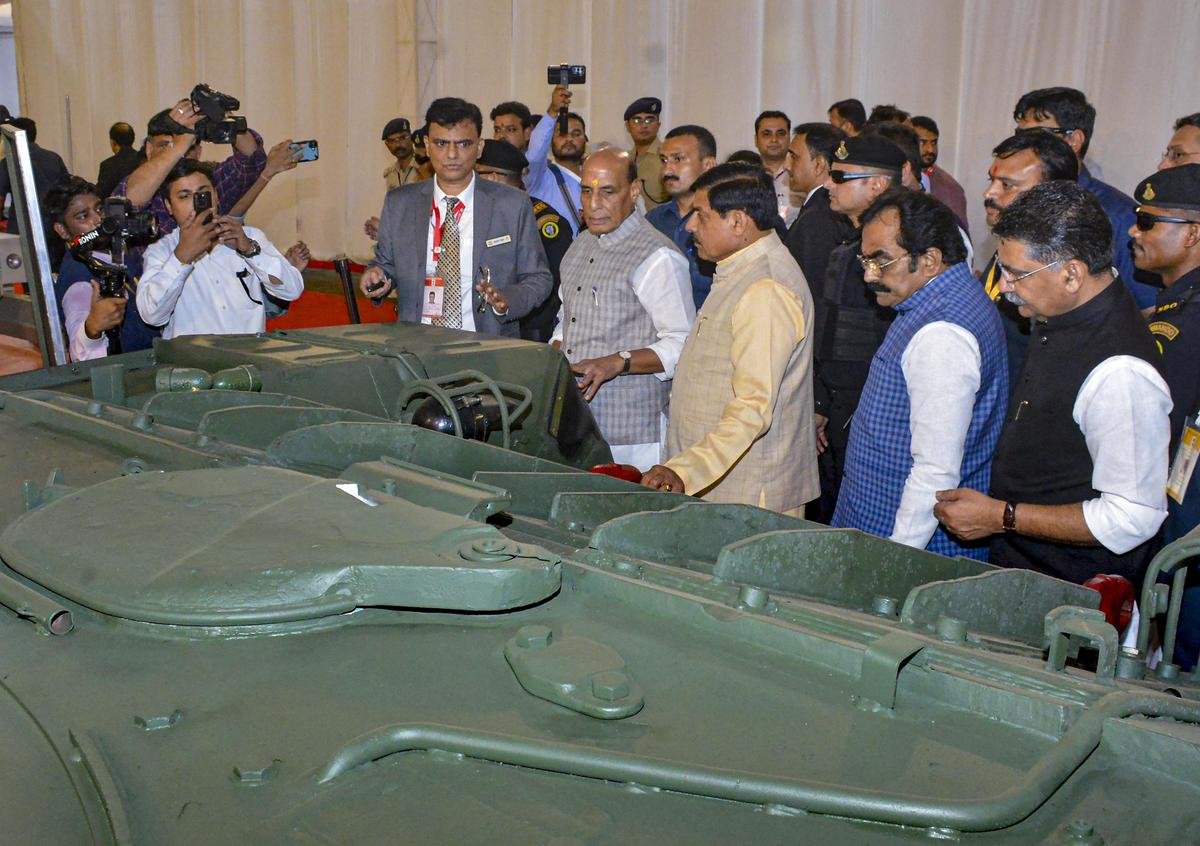
Rajnath Singh Hails Main Battle Tanks as Border ‘Iron Wall’, Launches ₹472-Crore Overhaul Hub in Jabalpur
JABALPUR: Reaffirming the enduring dominance of armored cavalry on the frontline, Defence Minister Rajnath Singh on Thursday laid the foundation stone for a state-of-the-art T-series tank overhaul facility at the Vehicle Factory Jabalpur (VFJ), backed by an investment of ₹472 crore.
Describing modern Main Battle Tanks (MBTs) like the T-72 and T-90 as an impenetrable “iron wall” shielding the nation’s borders, the Defence Minister emphasized that the rise of unmanned platforms, precision strikes, and artificial intelligence has adapted—rather than diminished—the critical strategic role of heavy armor.
— Defence Minister Rajnath Singh
The Indian Army requires the periodic overhauling of approximately 230 T-series main battle tanks every year to guarantee relentless operational readiness. Currently, the Heavy Vehicles Factory (HVF) at Avadi, Tamil Nadu, handles roughly 150 units annually.
The newly sanctioned facility at VFJ—a key manufacturing arm operating under Armoured Vehicles Nigam Limited (AVNL)—is designed to overhaul 80 T-72 and T-90 tanks per year, completely closing the existing service deficit within the domestic infrastructure.
| Facility / Metric | Annual Capacity / Target | Strategic Impact |
|---|---|---|
| HVF Avadi (Tamil Nadu) | ~150 Tanks / Year | Primary maintenance & production base |
| New VFJ Facility (Jabalpur) | 80 Tanks / Year | Bridges the remaining overhaul shortfall |
| Total Annual Demand | ~230 Tanks / Year | 100% domestic overhaul readiness |
| Project Outlay | ₹472 Crore | Strengthens AVNL & regional MSME ecosystem |
Reflecting on contemporary protracted conflicts such as the ongoing Russia-Ukraine war, Rajnath Singh observed that nations capable of sustaining extended campaigns depend on three core pillars: resilient domestic supply chains, robust heavy industrial infrastructure, and swift indigenous technological innovation.
The Defence Minister stressed that rather than replacing armored assets, modernization must equip tanks with cutting-edge sensors, electronic warfare countermeasures, and integrated command architectures aligned with evolving combined-arms warfare.
The establishment of the overhaul center in Madhya Pradesh is set to generate substantial industrial demand across mechanical, hydraulic, electrical, and sensor technologies. This will directly stimulate local MSMEs, expand ancillary manufacturing clusters, and create sustainable employment for engineers, technicians, and local youth across the Mahakoshal region.
Highlighting India’s sweeping transformation in defence manufacturing over the past decade, Singh shared key benchmarks:
- Indigenous Production: Grown from ₹46,000 crore in 2014 to roughly ₹1.80 lakh crore.
- Defence Exports: Surged from around ₹1,000 crore in 2014 to nearly ₹39,000 crore.
- Export Goal: On track to achieve the target of ₹50,000 crore in defence exports by 2028-29.
Joined by Madhya Pradesh Chief Minister Dr Mohan Yadav during the traditional ‘bhoomi pujan’, Singh concluded that the project firmly cements Jabalpur’s position as a premier node for modern military engineering, domestic sustainment, and high-readiness manufacturing.