

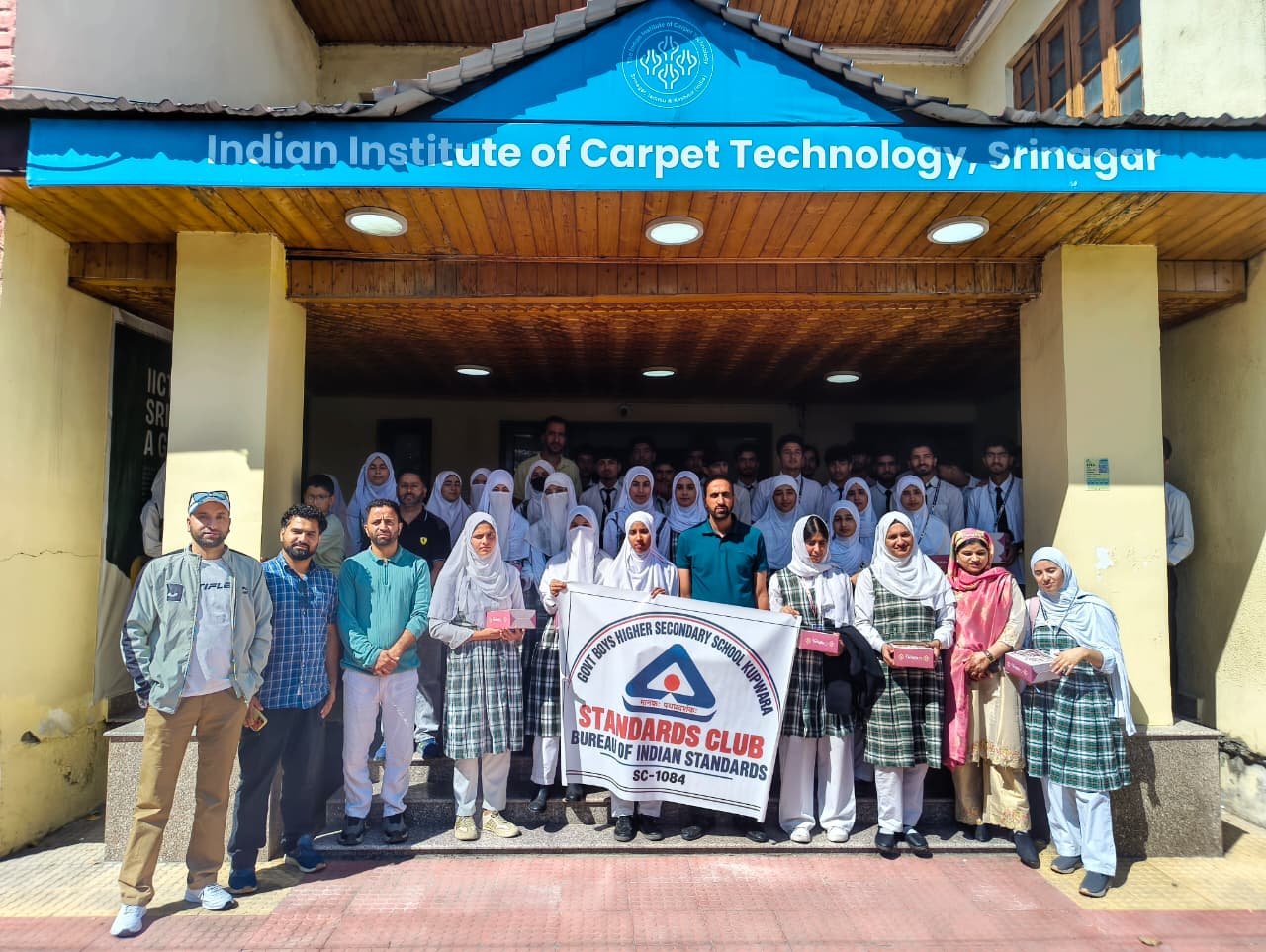
Preserving Heritage Through Science: BIS Standards Club Organises Exposure Tour for Kupwara Students to IICT Srinagar
Over 45 students explore modern quality benchmarks, CAD digitisation of traditional ‘Kaleen Taleem’, and certified manufacturing standards for Kashmiri silk floor coverings.
In an effort to blend hands-on science education with traditional craft preservation, the Bureau of Indian Standards (BIS) organised an immersive educational exposure visit for more than 45 students from Government Boys Higher Secondary School (BHSS), Kupwara, to the premier Indian Institute of Carpet Technology (IICT) in Srinagar.
Organised under the aegis of the Ministry of Consumer Affairs, Food & Public Distribution, Government of India, through its nationwide BIS Standards Club initiative, the visit gave young minds a clear view of how high-tech manufacturing, scientific testing, and national standards preserve Kashmir’s iconic carpet-weaving heritage.
Bridging Tradition with Technology
- Deciphering Kaleen Taleem: Students were introduced to the cryptic, coded design script historically used by Kashmiri carpet weavers to draft intricate motifs.
- Digital Archiving: Learners saw firsthand how Computer-Aided Design (CAD) technology is digitising historic manuscripts. IICT has digitally archived over 551 authentic carpet designs and Taleem manuscripts to preserve the region’s cultural heritage.
The visiting students explored the industrial evaluation process behind hand-knotted textiles, receiving a detailed briefing on IS 14566:2023 (Textile Floor Covering — Hand-Knotted Silk Carpets — Specification). Experts demonstrated the scientific parameters required to meet certified Indian standards.
The tour gave students a complete look at the supply chain: from conceptual design and Taleem transcription to knotting, scientific testing, and final quality certification.
The BIS Standards Club conducts industry visits, laboratory demonstrations, and specialized workshops to bring standardisation principles into school curriculums across the Union Territory, helping students see how certified safety and quality metrics support both consumer trust and local industries.