




NCERT withdraws Class 8 textbook after judiciary ‘corruption’ row
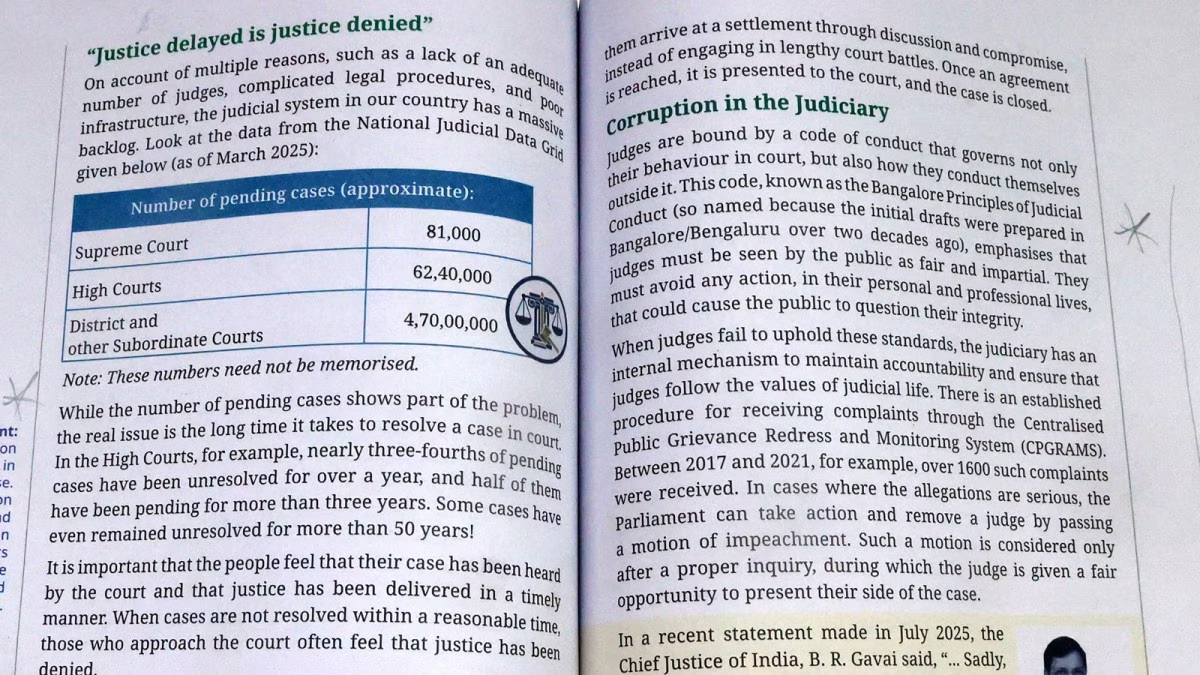
The National Council of Educational Research and Training (NCERT) has stopped the distribution of a Class 8 textbook after a chapter referring to “corruption” in the judiciary triggered sharp criticism and reached the Supreme Court, prompting the council to order a review of the content.
The move, confirmed by NCERT officials, comes amid concerns that the contested passage could undermine public confidence in the judicial system at a time when the higher judiciary itself is under intense public scrutiny.
What triggered the controversy
The controversy centres on a section in a social science book prescribed for Class 8 students, where the judiciary was mentioned in the context of corruption along with other public institutions.
Legal experts and educators argued that the framing was overly sweeping and did not sufficiently distinguish between isolated instances of wrongdoing and the institutional role of the courts as guardians of the Constitution, especially for young readers who are just beginning to understand civics.
Supreme Court takes note
The row escalated when the issue was brought to the notice of the Supreme Court, which expressed concern over textbook content that could send misleading signals about the functioning of the judiciary to impressionable students.
According to reports, the court indicated that educational material must strike a careful balance between speaking honestly about social problems and preserving trust in constitutional institutions, especially when it comes to school-level textbooks.
NCERT halts distribution, orders review
Following the Supreme Courts observations, NCERT announced that the book would no longer be distributed and that the controversial section would be reviewed by subject experts and senior officials.
Officials indicated that future editions may carry revised text that discusses corruption as a systemic challenge without singling out the judiciary in a manner that could be read as a blanket indictment of judges or courts.
Debate over how to teach corruption
The episode has reignited a wider debate on how schools should introduce complex topics such as corruption, accountability and institutional checks and balances to adolescents.
Educationists point out that it is important to speak candidly about misuse of power, but that classroom material must also explain the mechanisms that exist within institutions, including the judiciary, to investigate and punish wrongdoing so that students do not leave with a purely cynical view of governance.
Several teachers have underlined the need for age-appropriate discussions that distinguish between individual acts of corruption and the constitutional role of courts, legislatures and the executive, so that students understand both the challenges and the safeguards embedded in Indias democratic framework.
Reactions from the legal fraternity
Members of the legal fraternity welcomed the decision to review the chapter, arguing that while judicial corruption cannot be denied, portraying the entire institution through that narrow lens in a school textbook is pedagogically unsound.
Some senior advocates have suggested that if corruption in the judiciary is to be mentioned, it should be presented alongside landmark judgments, internal accountability procedures and the role of the Supreme Court and High Courts in safeguarding fundamental rights.
Concerns of teachers and parents
On the ground, teachers say they often find themselves answering difficult questions from students when controversial content surfaces in textbooks, especially in the age of social media where headlines travel faster than classroom explanations.
Parents, too, have become more vocal about what is taught in school, demanding clearer communication from boards, publishers and school managements whenever contentious material is modified or withdrawn mid-session.
Impact on schools and students
With the book now withdrawn, many schools associated with national boards are awaiting formal instructions on whether to skip the affected chapter, replace it with supplementary material, or adopt an alternative text for the remainder of the academic year.
Teachers say that, in the short term, they are likely to use their own notes to discuss the structure and functions of the judiciary, while steering clear of phrasing that could be interpreted as a sweeping comment on corruption in courts.
For students preparing for competitive exams later in their academic journey, clarity on fundamental concepts of the justice delivery system, separation of powers and accountability will remain crucial, making it important that the revised content, whenever released, is precise and balanced.
Call for stronger textbook vetting
The incident has once again highlighted the need for a stronger, transparent pre-publication review mechanism for school textbooks, particularly on politically and socially sensitive topics.
Experts argue that multi-layered vetting committees, including classroom teachers, academics, child psychologists and representatives from marginalised communities, can help identify problematic framing, stereotypes or oversimplifications before books reach millions of students.
There is also growing demand for periodic audits of existing textbooks to ensure that they reflect current constitutional values, judicial pronouncements and evolving social realities, rather than remaining frozen in the context in which they were first written.
What happens next
NCERT is expected to place the chapter before expert panels that will examine whether the language can be reframed to discuss corruption in public life more holistically, with concrete examples of institutional reforms and citizen-led accountability movements.
Until the review is completed and revised material is released, schools have been advised to follow board circulars and focus on broader learning outcomes in civics, such as understanding constitutional principles, rule of law and the idea of checks and balances.
The Supreme Courts intervention and NCERTs prompt response are being viewed as a reminder that textbook content is not merely academic but carries long-term implications for how young citizens perceive the institutions that shape Indias democracy.
As the debate continues, stakeholders across the education and legal sectors agree that the goal should be to foster critical thinking without eroding faith in constitutional bodies, ensuring that future generations grow up informed, questioning and yet confident in the promise of justice.