



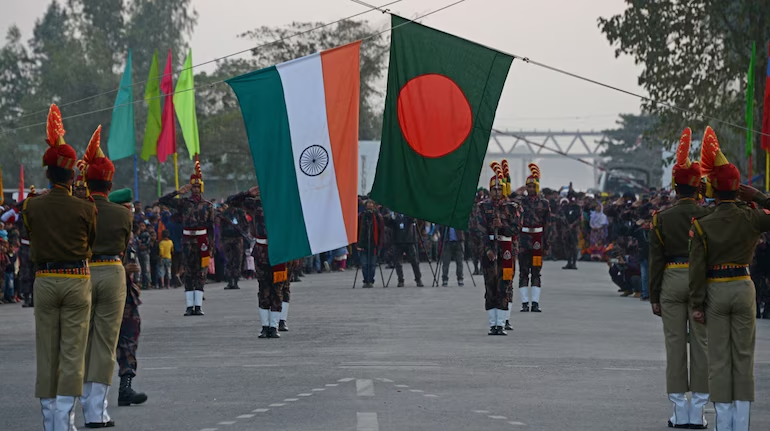
According to officials familiar with the development, the Ministry of External Affairs (MEA) has advised dependents of Indian personnel at the High Commission in Dhaka and four Assistant High Commissions in Chattogram, Khulna, Rajshahi and Sylhet to leave Bangladesh as a precautionary security measure. The missions themselves will remain open and are expected to function at full diplomatic strength despite the withdrawal of families.
Security concerns ahead of Bangladesh polls
The move comes weeks before Bangladesh goes to the polls on February 12, in an election that will also coincide with a referendum on the July Charter, amid reports of sporadic violence, protests and heightened activity by extremist groups. Indian authorities have cited threats from radical and extremist elements, as well as recent incidents near Indian diplomatic premises, including protests outside the Chattogram mission, as key reasons for tightening security.
Sources have underlined that the step is “purely precautionary” and aimed at ensuring the safety of diplomats’ families rather than signalling any interruption in India’s diplomatic engagement with Dhaka. However, the decision reflects the sharp strain in India–Bangladesh ties since an interim government led by Muhammad Yunus took charge in August 2024 following the exit of Sheikh Hasina.
Bangladesh now a ‘non‑family’ posting
With this decision, Bangladesh has effectively been designated a “non‑family” diplomatic posting for Indian officials, one of the strictest security classifications used by New Delhi for its missions abroad. Officials pointed out that a similar restriction already exists for postings in Pakistan, where children are not permitted to stay with mission staff, underscoring the seriousness of the security assessment.
Over a dozen families of Indian diplomats and staff stationed in Dhaka and the consulates are understood to have already returned to India in recent days, some using a special aircraft arranged by the government. Additional time has reportedly been granted in select cases involving school‑going children so that they can complete ongoing academic requirements before travelling.
MEA’s stance and operational status
MEA sources have emphasised that despite the withdrawal of dependents, day‑to‑day functioning of the Indian High Commission and all consular offices in Bangladesh will continue without disruption. The number of Indian diplomats and officials deployed in the country has not been disclosed publicly, with the government citing security sensitivities.
New Delhi has consistently reiterated that it supports peace, stability and free, fair and inclusive elections in Bangladesh, even as it raises concerns over attacks on minorities and the space allegedly given to radical outfits. Indian officials have also privately conveyed unease over what they describe as inadequate protection for minority communities, especially Hindus, in the run‑up to the polls.
Backdrop of strained bilateral ties
India–Bangladesh relations have been under pressure since 2024, with New Delhi and Dhaka exchanging sharp words over political developments, protests and the role of exiled Bangladeshi leaders. Both sides have stepped up security outside each other’s missions after demonstrations in recent months, and Dhaka has previously reacted strongly to India’s comments on its internal political process.
At the same time, India has engaged with key political players in Bangladesh, including the Bangladesh Nationalist Party (BNP), which is widely expected to emerge as a major force in the February 12 election. Diplomatic observers say the decision to recall families while keeping missions fully operational underlines India’s attempt to balance security imperatives with the need to maintain continuous political and consular outreach.
• Families and dependents of Indian diplomats asked to return from Bangladesh as a security precaution.
• All five Indian missions in Bangladesh remain open and fully functional.
• Bangladesh classified as a temporary “non‑family” posting amid rising extremist activity and pre‑poll tensions.
• Step seen as a strong security signal, but not a downgrading of diplomatic ties.