
Central Delhi Turned into Fortress as INDIA Bloc Marches to Election Commission; Rapid Action Force Deployed Amid Electoral Roll Row
NEW DELHI: The political confrontation between the ruling establishment and the joint opposition escalated dramatically on Tuesday as MPs of the Indian National Developmental Inclusive Alliance (INDIA) commenced a high-stakes protest march from Parliament towards the Election Commission of India (ECI) headquarters. Demanding the immediate resignation of Chief Election Commissioner Gyanesh Kumar over alleged unilateral administrative maneuvers and controversies surrounding the Special Intensive Revision (SIR) of voter rolls, opposition parliamentarians mounted their strongest offensive yet against the electoral watchdog.
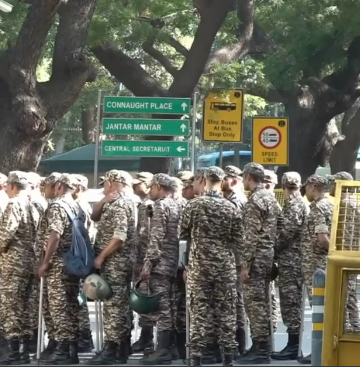
Anticipating widespread disruption, the Ministry of Home Affairs and the Delhi Police placed central parts of the national capital under unprecedented security cordons. Columns of anti-riot police, bolstered by heavily equipped Rapid Action Force (RAF) contingents, took control of Parliament Street, Ashoka Road, Jantar Mantar, and perimeter roads leading to Nirvachan Sadan. Multi-tiered steel barricades, spiked obstacles, and riot-control water cannon vehicles were positioned across key intersections to block demonstrators.
Key Developments at a Glance
- Parliament to Nirvachan Sadan: Top opposition leaders, including Mallikarjun Kharge, Rahul Gandhi, and regional party heads, assembled at Makar Dwar to launch their march.
- Massive Security Influx: Over 5,000 security personnel and paramilitary forces stationed around India Gate, Jantar Mantar, and Patel Chowk.
- Judicial Oversight: Supreme Court issued notices to the Union Government and ECI, scrutinizing decisions and raising questions regarding voter enrollment Form 6 modifications.
- Commuter Woes: Massive traffic diversions announced by Delhi Traffic Police across Central Delhi, impacting Lutyens’ corridors and Connaught Place fringes.
From Makar Dwar to Barricades: Opposition Takes to the Streets
The showdown began in the morning when dozens of opposition lawmakers, holding banners and chanting slogans against what they termed an “erosion of democratic integrity,” gathered at the historic Makar Dwar of Parliament House. Led by Congress President Mallikarjun Kharge, Rahul Gandhi, Trinamool Congress’s Abhishek Banerjee, and Samajwadi Party chief Akhilesh Yadav, the delegation resolved to confront the poll panel directly before scheduling a delegation visit to President Droupadi Murmu.
However, within minutes of stepping outside the parliamentary complex, the leaders ran into formidable police cordons. Sizable detachments of RAF personnel in full riot gear stood firm at Akashvani circle and Ashoka Road, halting the advance and turning the area into a standoff zone. Several leaders squatted on the tarmac in protest, accusing the government of weaponizing administrative mechanisms to stifle legitimate constitutional scrutiny.
Supreme Court Scrutiny and Internal ECI Rift
The urgency of Tuesday’s protest was further fueled by proceedings inside the Supreme Court of India. A bench presided over by Chief Justice Surya Kant issued formal notices to the Centre, the ECI, and the Commissioners in response to petitions challenging administrative conduct within the commission. The petition submitted that fourteen vital policy decisions—including the controversial voter revision process—were carried out unilaterally without building consensus among fellow Election Commissioners Sukhbir Singh Sandhu and Vivek Joshi.
Crucially, the top court underscored that it had not cleared any revised iteration of Form 6, the statutory document deployed for voter enrolments during the Special Intensive Revision. The apex court indicated that it would thoroughly examine original institutional records to ascertain whether executive decisions adhered to statutory collective-decision frameworks, cautioning that non-compliant actions could face legal nullification.
“The credibility of constitutional bodies forms the bedrock of our republic. When statutory enrollment procedures are altered without consensus, it is not merely an administrative flaw—it strikes at the heart of adult franchise.” — Opposition Memorandum Submitted to the Poll Panel
Days of Unrest at Jantar Mantar and Simmering Friction
Tuesday’s parliamentary march follows three consecutive days of violent friction around Jantar Mantar and India Gate. Student outfits including AISA alongside youth wings of opposition parties have engaged in recurrent standoffs with security forces, resulting in over 120 detentions, blockades of transport vehicles, and minor clashes over the weekend. Compounding the tensions were serious complaints filed by women journalists and protesters regarding heavy-handed police actions during earlier detentions.
In response to escalating street mobilizations, Delhi Traffic Police issued urgent travel advisories. Extensive diversions were enforced on KG Marg, Ashoka Road, Tolstoy Marg, Sansad Marg, and Janpath, triggering bumper-to-bumper congestion across Connaught Place outer circles and Central Secretariat arteries throughout the morning peak hours.
Political Counterfire: Institutional Defense vs. National Agitation
The Election Commission has forcefully defended its conduct, denying any allegations of unilateral authority. Officials maintain that the voter roll revision was executed transparently in line with established legal statutes and collective commission practices. Concurrently, leaders of the ruling Bharatiya Janata Party (BJP) launched a sharp counter-offensive, asserting that the opposition was attempting to undermine the autonomy of a respected constitutional institution ahead of crucial democratic exercises.
Unfazed by pushback, the INDIA bloc has prepared an extended national roadmap to sustain pressure. Party strategists confirmed that the current demonstration is the precursor to block-level ‘Save Vote, Save Country’ movements scheduled through mid-October, culminating in a mega-rally at Ramlila Maidan on November 1 and unified convergence marches on Constitution Day. As the Supreme Court prepares to examine documentary evidence, the political confrontation over India’s electoral oversight shows no signs of abating.