

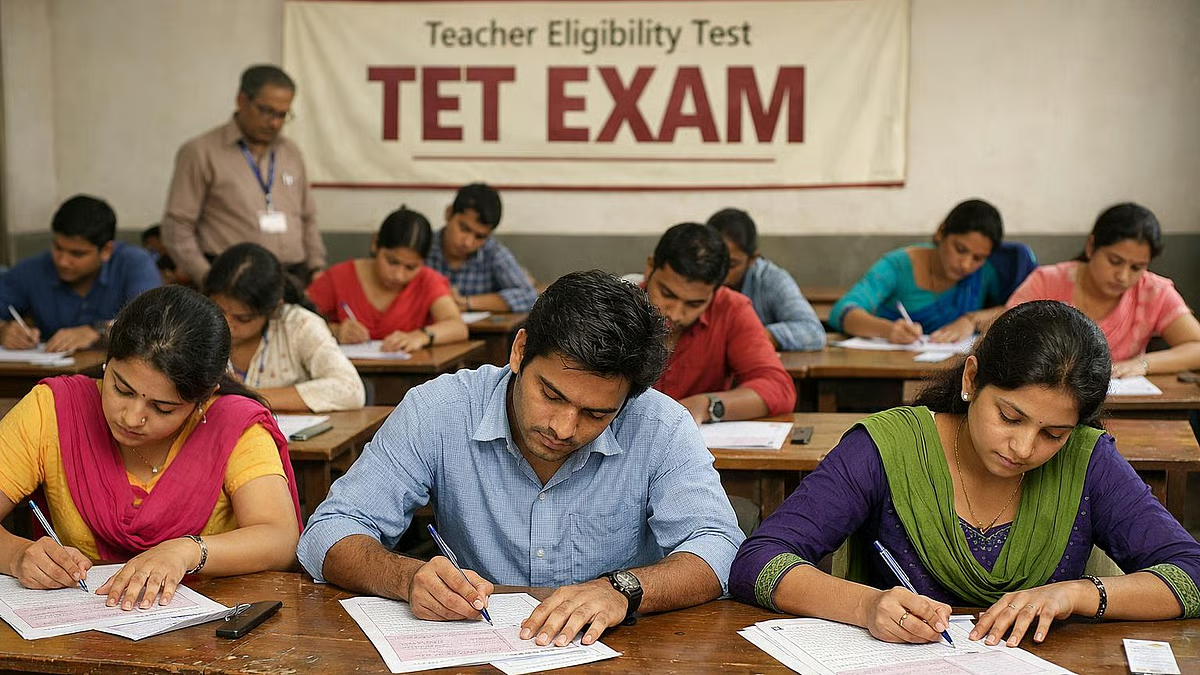
Ministry of Education Proposes Comprehensive Review of TET Framework, Eyes Legislative Relief for In-Service Teachers
Centre issues office memorandum following Supreme Court observations and widespread stakeholder representations; multi-tier consultations planned with States, UTs, and NCTE on statutory amendments.
Key Policy Highlights at a Glance
- ✓ Holistic TET Overhaul: Centre proposes examining the entire eligibility, qualification, and evaluation framework.
- ✓ In-Service Teachers Relief: Practical hurdles faced by already-serving faculty in obtaining TET to be specifically addressed.
- ✓ Supreme Court Alignment: Review addresses judicial directives and observations regarding the RTE Act 2009.
- ✓ Statutory Amendments: Government weighing appropriate legislative changes to relevant legal provisions in public interest.
- ✓ Periodic & Regular Testing: Mandating tests at predictable, reasonable intervals to curb multi-year lapses.
- ✓ Broad Consultation: Active collaboration with State Governments, UT Administrations, NCTE, and educational experts.
In a monumental move set to impact hundreds of thousands of educators across the country, the Union Ministry of Education (MoE) has proposed to undertake comprehensive measures pertaining to the Teacher Eligibility Test (TET). The initiative aims to overhaul the existing regulatory architecture, ease persistent hurdles for serving educators, and potentially initiate legislative revisions in the governing statutes.
According to an official memorandum issued by the Ministry of Education, the central government has initiated this exhaustive review in light of emerging challenges surrounding teacher qualifications, recruitment parity, and pedagogical standards in schools nationwide.
“The Ministry of Education, Government of India, has taken note of various representations and issues being raised by teachers, teacher associations, educational institutions and other stakeholders regarding the implementation of the TET requirement.”
Judicial Directives & Alignment with the RTE Act 2009
A cornerstone driver for the ongoing review stems from legal disputes and observations rendered by the judiciary. The Ministry confirmed that it has factored in key directions and observations passed by the Supreme Court of India concerning the mandatory requirement of TET for school teachers governed under the Right of Children to Free and Compulsory Education (RTE) Act, 2009.
For years, ambiguity over retrospective cut-off dates, exemption provisions, and state-level implementation variations resulted in prolonged court litigations, jeopardizing the career progression and job stability of senior in-service teachers.
Core Focus Areas of the Proposed Review
The official policy blueprint outlined by the Ministry identifies critical operational and legislative components currently slated for detailed deliberation:
Eligibility Criteria Overhaul
Examination of the existing benchmark qualifications, syllabus alignments, and threshold criteria governing eligibility for primary and upper-primary educators.
In-Service Teachers Relief
A comprehensive inquiry into the realistic obstacles and practical difficulties experienced by veteran serving teachers who are mandated to acquire TET credentials late into their careers.
Periodic Exam Schedules
Formulating binding mechanisms ensuring TET examinations are held periodically and at reasonable, disciplined intervals to avoid recruitment backlogs across states.
Statutory Amendments
Evaluating if legislative amendments to the relevant provisions of the RTE Act and related guidelines are necessary to safeguard public interest and institutional stability.
States, UTs, and NCTE to be Part of Formal Consultations
Recognizing the diverse administrative and educational realities across regions—particularly in Union Territories like Jammu & Kashmir and Ladakh—the Ministry highlighted that reforms will not be executed in isolation.
The Centre affirmed that an exhaustive consultative mechanism is being set up involving State Governments, Union Territory Administrations, the National Council for Teacher Education (NCTE), prominent pedagogical experts, and institutional stakeholders.
The review committee will evaluate whether statutory modifications under parliamentary framework are necessitated to harmonize teacher career security with quality educational outcomes for schoolchildren across the country.