
BRICS Condemns Pahalgam Attack ‘in Strongest Terms’ in Landmark New Delhi Declaration
The summit firmly demands zero tolerance toward terrorism, resolute action against cross-border movement of terror operatives, illicit terror financing networks, and dismantle safe havens.
NEW DELHI: In a resolute and united diplomatic stand, BRICS leaders on Friday condemned the April 22, 2025 terrorist attack in south Kashmir’s Pahalgam “in the strongest terms.” The deadly assault claimed the lives of 26 people and left several others injured. The leaders unequivocally reaffirmed their collective commitment to combating terrorism in all its forms and manifestations.
In the formally adopted New Delhi Declaration, the multi-nation grouping described all acts of terrorism as “criminal and unjustifiable,” regardless of their motivation. The summit underlined that acts of terror must be systematically condemned wherever and by whomever they are committed.
Highlights of the New Delhi Declaration
- Unanimous Condemnation: Denounced the April 22, 2025 Pahalgam attack, mourning 26 lives lost and expressing deep solidarity with victims.
- Zero Tolerance: Urged the global community to reject double standards in counter-terrorism operations.
- Cross-Border Networks: Called for dismantling safe havens, choke points for terror financing, and cross-border infiltration routes.
- CCIT Treaty: Demanded the early finalisation and adoption of the Comprehensive Convention on International Terrorism under the UN framework.
Specifically denouncing the bloodshed in Pahalgam, member nations expressed heartfelt solidarity with the victims, their families, and all those impacted by the tragedy.
Reaffirming their resolve to eliminate terrorism, BRICS member states stressed the urgent imperative to choke the cross-border movement of terrorists, dismantle terror financing pipelines, and deny safe havens to extremist syndicates.
The declaration explicitly underscored that terrorism must never be associated with any religion, nationality, civilisation, or ethnic group. It insisted that all individuals and entities involved in orchestrating, sponsoring, or supporting terrorist operations must be held accountable and brought to justice in full alignment with national legal frameworks and international law.
Taking aim at selective counter-terror stances, the bloc called upon the international community to adopt a clear and unyielding policy of “zero tolerance” towards terrorism, while completely rejecting double standards.
The leaders further emphasised that sovereign states bear the primary responsibility for preventing and confronting terrorism within and across borders. Global counter-terrorism mechanisms, the declaration added, must strictly adhere to international obligations, including the UN Charter, international human rights law, refugee law, and international humanitarian law.
The summit also applauded the continued contributions of the BRICS Counter-Terrorism Working Group and its five specialised subgroups operating under the BRICS Counter-Terrorism Strategy and Action Plan, pledging deeper institutional cooperation.
Reiterating their broader multilateral agenda, the leaders pressed for the prompt conclusion and adoption of the Comprehensive Convention on International Terrorism (CCIT) under the United Nations framework, demanding coordinated international action against all terrorists and entities designated by the UN Security Council.
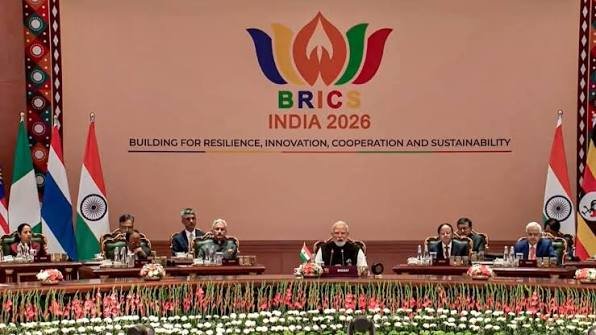
Under India’s presidency—which commenced on January 1, 2026—the summit took place at the Bharat Mandapam convention complex in New Delhi from September 12 to 13. The high-level conclave brought together leaders and delegations across member nations: Brazil, Russia, India, China, South Africa, Egypt, Ethiopia, Iran, the United Arab Emirates, and Indonesia.