

NEW DELHI, Aug 24: The BJP on Monday hit back at Congress over its charge that the Modi government is pursuing an “aggressive privatisation agenda” in the space sector, asserting that the expansion of private participation is enabling ISRO to focus on frontier missions while industry scales up manufacturing and launch capabilities.
The remarks came after Congress general secretary in-charge communications Jairam Ramesh accused the government of “strangulating and emasculating” the Indian Space Research Organisation (ISRO) and pursuing an aggressive privatisation agenda for the space programme just as it has for nuclear energy.
Ramesh claimed recent reports about ISRO’s future role in India’s space programme raised “legitimate concerns”, given the capabilities built by the organisation over six decades.
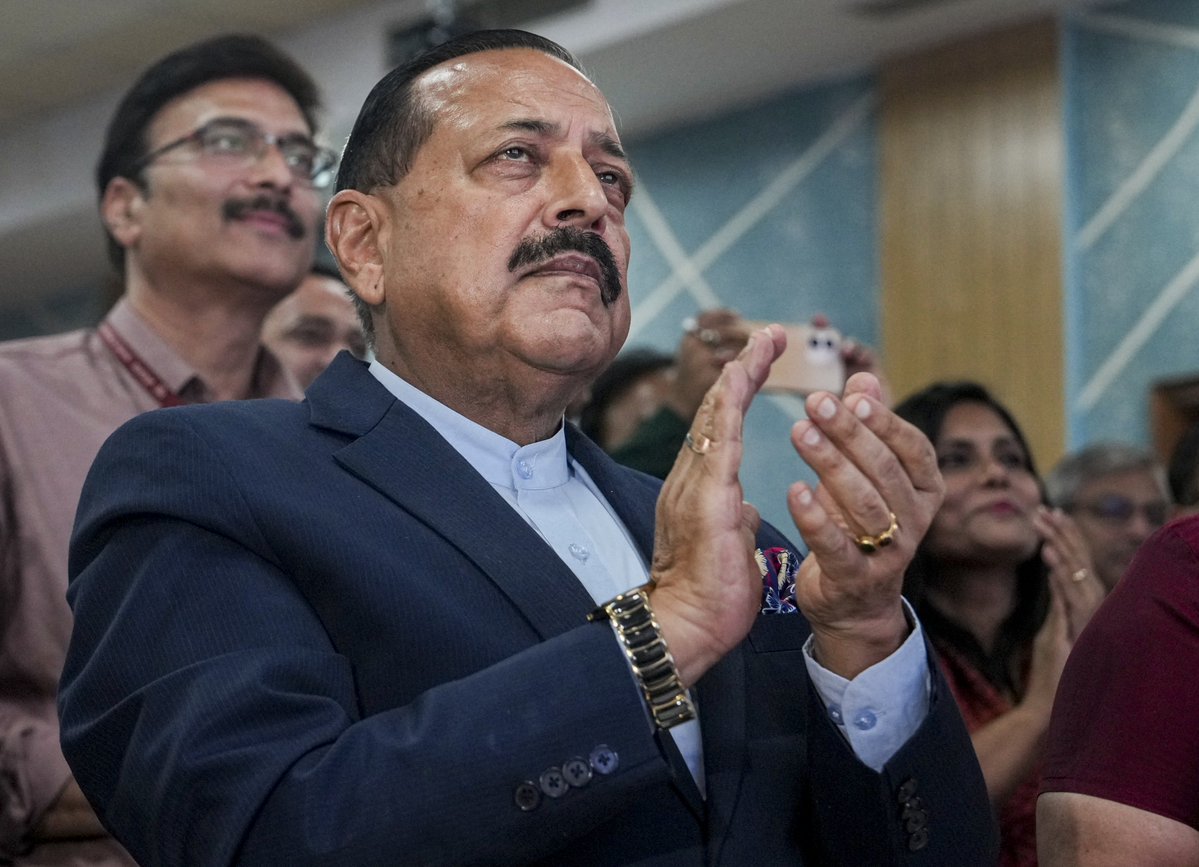
MoS (Space) Jitendra Singh rejected Ramesh’s criticism, saying India’s space programme is “not being scaled back, but being scaled up”, with ISRO focusing increasingly on frontier missions such as Gaganyaan, Chandrayaan-4 and the Bharatiya Antariksh Station, as well as future missions to the Moon, Venus and Mars.
“Under PM Narendra Modi, India’s space sector has taken a global trajectory by expanding from a predominantly government-led programme into a wholesome ecosystem integrating ISRO, industry and space startups. India’s space programme is not being scaled back. It is being scaled up,” he said in a post on X.
“At the same time, as India moves towards an ambition of 50 launches a year, industry has to become the manufacturer at scale, while ISRO develops the next generation of technologies and missions. This is the natural evolution of India’s space programme,” Singh added.
He accused Ramesh of “running down” Indian achievements and casting doubt on every step forward.
Citing the growth of the space sector and the emergence of private players, Singh said the number of foreign satellites launched by ISRO has risen from 35 before 2014 to 430 today, while the number of space startups has grown to around 440 from just a handful in 2014.
He cited Skyroot Aerospace’s Vikram-1 reaching orbit on July 18 this year as the first privately developed Indian rocket to do so.
“If India is to build a USD 44-billion space economy, we need many things happening simultaneously: ISRO research in the frontier technologies, private rocket factories, satellite manufacturing facilities, dedicated assembly, integration and testing infrastructure, commercially operated launch facilities, and a much deeper supply chain,” Singh said.
He noted that Sriharikota will remain at the heart of ISRO’s major launch programmes, including PSLV, LVM3 and human spaceflight, while Kulasekarapattinam will add capacity for the growing small-launch sector.
“That is not ISRO versus industry. The model is ISRO and industry together. Together, they are writing the next chapter of India’s space story,” Singh said.
BJP national spokesperson and national media co-in-charge Pradeep Bhandari also defended the government’s space sector reforms, saying the opening up of the sector has enabled private companies and startups to move from being suppliers to developers of rockets, satellites and complete space systems.
“From a largely government-driven programme to an emerging national space ecosystem. That is not the weakening of ISRO’s legacy. It is the expansion of India’s space ambition,” Bhandari said in a post on X.
He said private investment in the sector had risen from USD 100.5 million in 2021-22 to USD 618.5 million by March 2026, while NewSpace India Limited’s revenue had increased from Rs 321.77 crore in 2021-22 to around Rs 3,000 crore in 2024-25.
Bhandari cited Chandrayaan-3’s soft landing near the Moon’s south polar region and the development of LVM3 and SSLV as milestones in India’s space programme.
“ISRO gave India a formidable technological foundation over decades. The Modi government’s reforms have sought to build on that legacy by enabling ISRO, private industry, startups and investment to grow together,” he said.
“Jairam ji, I understand your frustration with India’s remarkable journey in space. But the numbers tell a story that is difficult to ignore,” Bhandari said.