




World / West Asia
SHOCKING: US–Iran War Erupts After Devastating Joint US–Israeli Strikes on Iran!
By State Correspondents News Desk | 01 March 2026 |
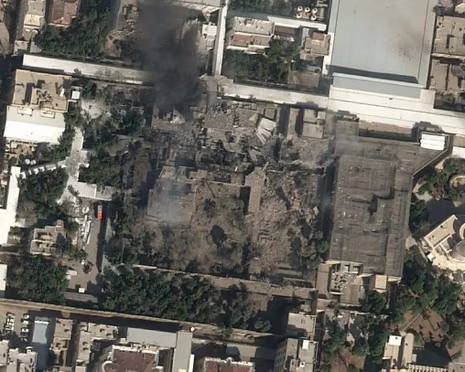
The Middle East has been plunged into a dangerous new war after the United States and Israel launched coordinated strikes against multiple targets inside Iran, prompting Tehran to respond with ballistic missiles and drones against US military bases and states hosting American forces across the Gulf. The escalation, which Washington has described as the start of “major combat operations”, follows weeks of mounting tensions over Iran’s nuclear and missile programmes and an unprecedented US military build‑up in the region.
Initial attacks were reported around Tehran and several other Iranian cities, where military facilities, command centres and air defence sites were struck in a wave of cruise missiles, drones and fighter jets. In response, Iran’s leadership ordered retaliatory strikes on American positions and bases in Bahrain, Qatar, Kuwait, Iraq and other Gulf states, signalling that the confrontation has already spilled far beyond Iran’s borders.
How The Latest War Broke Out
The current US–Iran war did not begin overnight; it is the violent peak of a months‑long crisis that started with nationwide protests inside Iran and harsh crackdowns by security forces. As images of the protests and state violence spread, US President Donald Trump repeatedly threatened military action, ordering a large naval and air build‑up that included aircraft carriers and strike groups moving towards Iran.
While back‑channel talks over Iran’s nuclear and missile activities continued through mediators in Oman and Europe, both sides hardened their public positions, with Washington demanding deeper restrictions and Tehran insisting it would not negotiate under threats. By late February, US intelligence and allied officials were openly warning that airstrikes on Iran were possible within days if diplomacy failed, raising fears of a direct war that many regional and global powers worked frantically to prevent.
Those warnings turned into reality when Israel carried out pre‑emptive strikes against Iranian targets, followed almost immediately by US attacks on Iranian military infrastructure, nuclear‑related facilities and command hubs. Trump later confirmed that American forces had joined the Israeli operation, framing it as a mission to dismantle Iran’s missile capabilities, weaken its armed forces and stop Tehran from ever acquiring nuclear weapons.
Massive Air Campaign Inside Iran
Military sources and independent analysts say the opening hours of the campaign saw hundreds of targets hit across western and central Iran, including air defence systems, missile launchers, logistics depots and communications nodes. The scale of the bombardment has been compared to the early phases of the 2003 Iraq war, with sustained waves of strikes aimed at blinding Iran’s defences and limiting its capacity to launch an organised response.
Reports from monitoring groups suggest that the joint force conducted hundreds of sorties and missile launches within the first half‑day of the offensive, with damage assessments still incomplete due to widespread internet blackouts inside Iran. Iranian state media has acknowledged “heavy attacks” on military facilities but has accused Washington and Tel Aviv of targeting civilian neighbourhoods as well, a claim US officials have denied while insisting they are focusing on “regime and military assets”.
The reported death of key Iranian commanders and the decapitation of elements of the leadership have triggered emergency political measures in Tehran, including the formation of a provisional body to manage state affairs during wartime. This sudden leadership vacuum adds a volatile political dimension to an already explosive military confrontation, raising questions about who ultimately controls Iran’s response and how far it is prepared to escalate.
Iran’s Missile Retaliation Across The Gulf
Within hours of the first strikes, Iran launched volleys of ballistic missiles and armed drones at US military installations and facilities associated with American forces in several Gulf Arab states. Air‑raid sirens sounded in cities such as Manama in Bahrain, where explosions and plumes of smoke were seen near the headquarters of the US Fifth Fleet, one of the most important American naval commands in the region.
According to regional officials and US Central Command statements, many incoming projectiles were intercepted by layered air‑defence systems, though some did hit their intended areas, causing damage and forcing temporary shutdowns of operations. Early US assessments have suggested there were no large‑scale American casualties in the first wave, but commanders warned that Iran appeared determined to continue its attacks and could be holding back more advanced capabilities for later stages.
Iranian leaders have framed their response as legitimate self‑defence under international law, vowing to keep striking US forces and what they call “aggressor regimes” until the joint campaign against Iran ends. At the same time, officials in Tehran have warned regional governments that allowing their territory to be used for operations against Iran makes them “part of the battlefield”, widening the war’s footprint across the Gulf.
Global Condemnation And Deep Concern
The United Nations Security Council held an emergency meeting to discuss the sudden escalation, with several members condemning both the initial US–Israeli strikes and Iran’s retaliatory attacks on neighbouring countries. Many governments have called for an immediate ceasefire and a return to diplomacy, warning that a prolonged US–Iran war could destabilise an already fragile region and trigger large‑scale refugee flows, economic shocks and new extremist violence.
Traditional US allies in Europe have expressed support for efforts to constrain Iran’s nuclear and missile programmes but have also stressed that any military action must comply with international law and be strictly limited in scope. Russia and China, meanwhile, have criticised Washington for what they describe as a reckless use of force that undermines global stability, even as they urge Tehran to avoid steps that could further inflame the situation.
Economic Shockwaves And Oil Market Jitters
The outbreak of open hostilities between the US and Iran has sent tremors through global energy markets, given Iran’s strategic position near the Strait of Hormuz, through which a significant share of the world’s seaborne oil trade passes. Traders fear that missile exchanges, naval skirmishes or deliberate attempts to disrupt shipping lanes could choke supplies, driving up crude prices and adding inflationary pressure to already fragile post‑pandemic economies.
Insurance costs for tankers transiting the Gulf have already begun to spike, and some shipping companies are reportedly rerouting vessels or temporarily suspending transits until the security picture becomes clearer. For import‑dependent countries in Asia, including India, escalating war risks directly translate into higher fuel bills, pressure on current account balances and renewed debate over strategic oil reserves and diversification of suppliers.
What This Means For India And The Region
India, which maintains strategic partnerships with both the United States and key Gulf states, while also historically engaging Iran on energy and connectivity projects, now faces a delicate diplomatic balancing act. New Delhi has consistently called for restraint and dialogue in US–Iran crises, aware that any long war could endanger millions of Indian expatriate workers in West Asia and disrupt vital economic links.
In the short term, Indian policymakers will be closely tracking fuel prices, the safety of shipping routes, and contingency plans to evacuate citizens if the conflict further widens. Over the longer term, the war is likely to accelerate discussions around energy diversification, regional security cooperation, and the need for de‑escalation mechanisms that prevent crises from spiralling into full‑scale wars.
Uncertain Road Ahead
As of now, neither Washington nor Tehran shows public signs of backing down, with the US leadership promising to keep hitting Iran’s military infrastructure and Iranian officials vowing to make American forces “pay a heavy price”. Analysts warn that miscalculations, new rounds of missile strikes or attacks by allied militias across the region could quickly draw in more countries and make it much harder to contain the conflict.
For ordinary people in Iran, Israel, the Gulf states and beyond, the top priority is simply survival, as they brace for more air‑raid sirens, explosions, blackouts and economic hardship in the days ahead. Whether the world witnesses a rapid ceasefire or a prolonged US–Iran war that reshapes the geopolitics of West Asia may depend on the next few decisions taken in Tehran, Washington and the world’s diplomatic capitals.