



PM Modi Slams Congress’ ‘Shirtless Protest’ At India AI Summit, Calls It ‘Shameless, Naked Politics
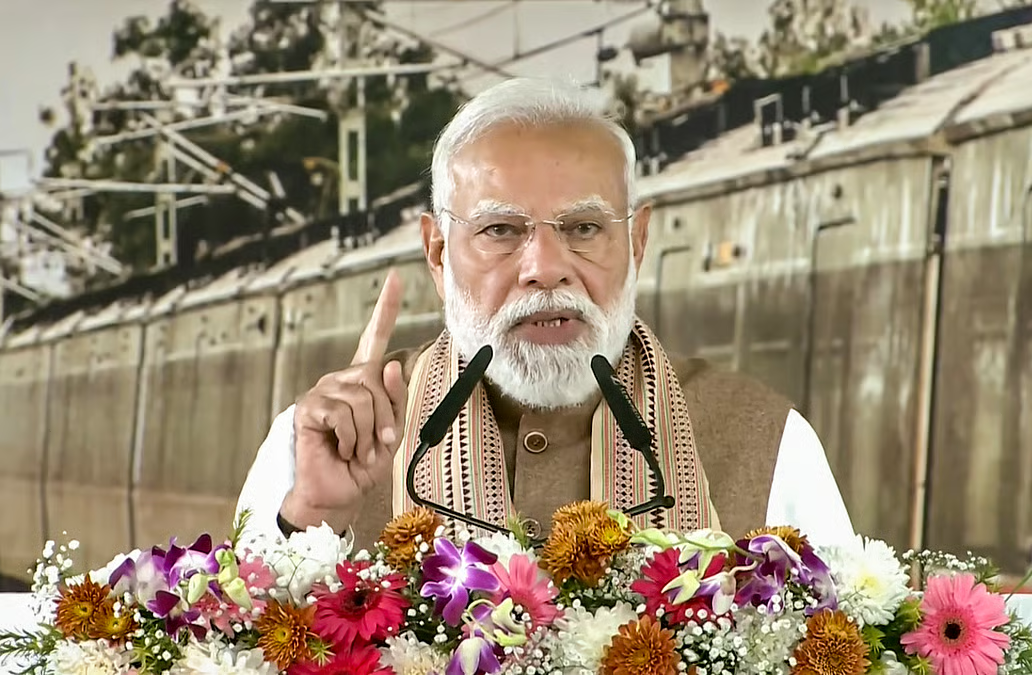
Prime Minister Narendra Modi on Sunday launched a blistering attack on the Congress over the Youth Congress’ dramatic shirtless protest during the India AI Impact Summit 2026 in New Delhi, accusing the opposition party of turning a global technology platform into an arena for what he described as “gandi aur nangi rajneeti” (dirty and naked politics).
Addressing a public rally in Meerut shortly after inaugurating key infrastructure projects, including the rapid rail and metro corridor connecting Delhi and Meerut, the Prime Minister said the country was “ashamed” that a high-profile artificial intelligence summit attended by delegates from more than 80 countries was used for a publicity stunt aimed at personally targeting him and defaming India on the world stage.
• PM Modi says Congress has turned “global AI summit into platform for dirty and naked politics”.
• Youth Congress workers staged a shirtless protest at Delhi’s Bharat Mandapam, raising slogans against the government over the India–US trade deal.
• Delhi Police has arrested several protesters and alleged a larger conspiracy inspired by Nepal’s Gen Z movement.
• Congress has defended the agitation as legitimate democratic protest while trading fresh barbs with the BJP.
What Triggered The Shirtless Protest At The India AI Summit?
The controversy erupted on Friday when a group of Indian Youth Congress activists gained access to the India AI Impact Summit venue at Delhi’s Bharat Mandapam after registering online and entering through QR code–based passes. According to Delhi Police, the young protesters initially wore jackets and sweaters over white T‑shirts and removed the outer layers near one of the halls before launching their brief but high‑voltage demonstration.
Eyewitness accounts and video clips from the scene show the workers going shirtless, shouting anti‑government slogans and waving T‑shirts printed with images of Prime Minister Modi and US President Donald Trump while raising objections to the government’s stand on a trade agreement with Washington. Security personnel quickly intervened, escorted the protesters out and later detained and arrested several of them on charges linked to unlawful assembly, disruption and security breach inside a high‑security zone.
PM Modi’s Sharpest Attack: ‘Desh Jaanta Hai Aap Pehle Se Nange Ho’
In his fiery speech in Meerut, Prime Minister Modi used some of his strongest language yet against the Congress, saying the party had crossed “all limits” of political decorum by staging such a protest in front of international guests, global CEOs and top AI experts gathered in the capital. He alleged that the incident exposed what he called the “ideological bankruptcy” of India’s oldest political party and signalled its desperation in the face of the country’s rapid technological and economic rise.
Modi also underlined that the AI Impact Summit was not a party event but a national programme hosted by India as part of a larger global conversation on the regulation and governance of emerging technologies, insisting that no BJP leader was present on the stage when the protest took place. He said that by disrupting an international conference, the opposition had “insulted the nation” rather than just its political rival.
Delhi Police, Court React Strongly To Security Breach
Following the incident, Delhi Police registered a case and launched a probe into how the Youth Congress members managed to slip through multiple layers of security arrangements put in place for the high‑profile summit. Senior officers later told the court that around ten activists were involved in the incident and that four to five had been taken into custody in the immediate aftermath, with more arrests following from other states including Madhya Pradesh.
In sensational submissions before the court, investigators claimed that the shirtless protest was not a spontaneous outburst but part of a larger conspiracy allegedly inspired by a violent Gen Z movement in neighbouring Nepal that had earlier targeted that country’s political leadership. The court, while sending the accused to police remand, observed that the act had the potential to imperil India’s international image and questioned the choice of platform for such a protest at a time when the world’s eyes were on India’s AI capabilities.
Congress Hits Back, Cites Legacy Of Protest
The Congress, however, has rejected the BJP’s criticism and police allegations, insisting that its Youth Congress cadre staged a symbolic, peaceful protest to highlight what it calls the government’s compromises in key trade and technology agreements with the United States. Party leaders have referenced the long tradition of non‑violent civil disobedience in India, including iconic protests led by Mahatma Gandhi, to argue that political dissent cannot be delegitimised merely because it makes those in power uncomfortable.
In a counter‑offensive on social media, Congress leaders also circulated old photographs of BJP leaders, including a now‑viral image of Haryana minister Anil Vij participating in a topless protest, claiming that the ruling party was being selective and hypocritical in branding the Youth Congress action as “shameless” and “naked politics”. They further accused Modi of using harsh, personal language to divert attention from questions being raised about transparency and accountability in the government’s AI‑related partnerships and international negotiations.
Global Optics And India’s AI Moment
The India AI Impact Summit 2026 has been widely projected as one of the largest artificial intelligence gatherings in the Global South, drawing participation from leading technology companies, researchers, policymakers and ministers from over 80 countries to discuss collaboration, safety frameworks and economic opportunities in the AI sector. For the government, the summit forms a crucial part of its narrative of positioning India as a trusted hub for responsible AI innovation and as a key voice in shaping global digital governance.
Analysts note that the shirtless protest and the political storm that followed have inevitably added a controversial layer to the summit’s legacy, with supporters of the government arguing that the incident damaged India’s carefully crafted image, while critics maintain that disagreements over policy are bound to surface even at high‑profile platforms. The sharp exchange of words between the BJP and Congress, triggered by the protest, underscores how rapidly emerging technology forums are now becoming arenas for intense political messaging and ideological battles in India’s charged pre‑election atmosphere.
What Lies Ahead?
With more court hearings, further investigation by Delhi Police and an escalating war of words between the ruling party and the opposition, the shirtless protest episode is likely to remain at the centre of the national political discourse in the coming days. The BJP is expected to continue projecting the incident as proof of what it calls the Congress’ “anti‑India” mindset, while the Congress will try to frame the controversy as a question of democratic freedoms, accountability and the right to protest against government decisions.
As the dust slowly settles on the AI summit, one clear takeaway is that India’s journey to becoming a global AI powerhouse will not be insulated from its intensely competitive domestic politics, where optics, symbolism and viral images often overshadow nuanced policy debate. For now, the political battle over a few minutes of shirtless sloganeering inside a global conference hall has opened up new questions about security, dissent and the fine line between robust opposition and what the Prime Minister calls “shameless politics” on the international stage.