



US-Israel War Against Iran Enters Second Week, Heavy Bombing Hits Tehran
By State Correspondents News Desk | Updated:
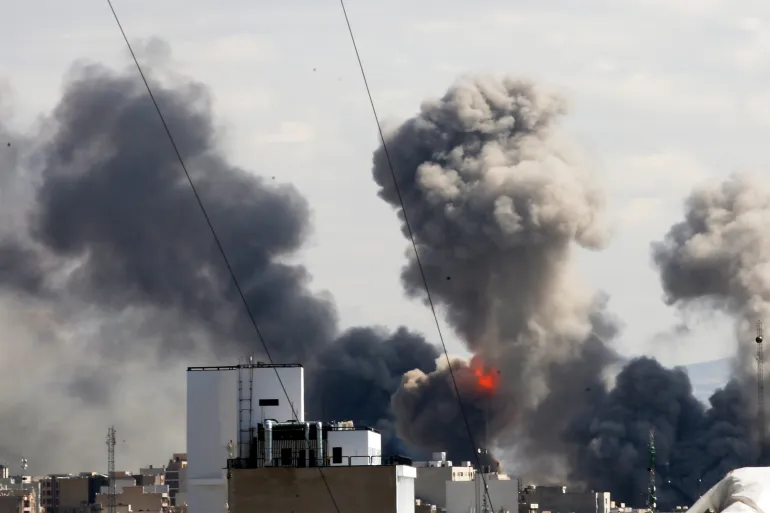
The US-Israel war against Iran has entered its second week, with intense waves of airstrikes pounding the capital Tehran and multiple other Iranian cities in one of the most serious escalations the Middle East has seen in years. Fighter jets, cruise missiles and long-range drones have been used to hit what Washington and Tel Aviv describe as key military and regime targets, even as humanitarian agencies warn of rising civilian casualties and mass displacement.
The campaign follows the launch of coordinated operations late last month, when the United States and Israel began a large-scale offensive against Iranian leadership, air defences and suspected nuclear and missile infrastructure under the codename “Operation Epic Fury” in Washington and “Operation Roaring Lion” in Israel. Those opening strikes reportedly hit sites in Tehran, Isfahan, Qom, Karaj, Kermanshah and other cities across the country, including facilities linked to Iran’s security establishment and nuclear programme.
Tehran and key cities pummeled by airstrikes
Over the last seven days, residents of Tehran have reported almost continuous explosions, with videos verified by international media showing fireballs and plumes of smoke rising over strategic neighbourhoods of the capital. Iranian officials say critical government complexes, command centres and transport hubs have been targeted, alongside radar systems, missile batteries and bases tied to the Islamic Revolutionary Guard Corps.
Local authorities have confirmed disruption to electricity, communications and internet services in parts of the city after repeated bombardment. Similar scenes have been reported from other urban centres, including the Gulf-facing province of Bushehr, where airports and military installations have come under attack. Iranian state media has highlighted strikes on civilian infrastructure, accusing the US and Israel of deliberately endangering non-combatants – a charge both governments reject, insisting they are focusing on what they call “regime infrastructure” and operational assets.
Trump demands Iran’s ‘unconditional surrender’
Politically, the war took a sharper turn when US President Donald Trump declared that there would be no agreement with Iran short of its “unconditional surrender”. Posting on his social media platform, the president said that only a complete capitulation by Tehran, followed by the emergence of what he called a “great and acceptable” new leadership, would bring the fighting to an end, signalling a shift from limited strikes to open-ended regime pressure.
Trump has framed the offensive as an opportunity for Iranians to “take back” their country, echoing earlier calls for a popular uprising against the Islamic Republic’s leadership. However, so far Iran’s political and military establishment has publicly projected defiance, vowing to continue resistance and retaliatory attacks across the region rather than submit to external demands about its internal political order.
Iran’s missile retaliation across the region
Within hours of the first strikes, Iran launched its own salvo of ballistic missiles and armed drones at targets in Israel and at US bases and facilities hosted in several Arab states in the Gulf. Tel Aviv and Haifa were among the Israeli cities placed under repeated rocket and missile alerts, while US military sites in countries such as Iraq, Qatar and the United Arab Emirates have reported incoming fire and intercept operations.
Iran has framed these attacks as part of an operation it calls “True Promise”, presenting them as legitimate retaliation for what it labels US-Israeli aggression. At the same time, allied non-state actors aligned with Tehran – including armed groups in Lebanon, Iraq and Yemen – have stepped up their own attacks on Israeli territory, US assets and shipping lanes, raising fears of a multi-front regional confrontation that could pull in even more actors over the coming days.
Civilian toll and humanitarian fears grow
As the conflict widens, the human cost is mounting. Early reports from Iranian media and international agencies point to significant civilian casualties, including women and children, following strikes that hit populated areas and public facilities such as sports halls and residential neighbourhoods. In some locations, emergency teams have struggled to reach victims because of damaged roads, unexploded ordnance and ongoing bombardment.
The United Nations and humanitarian organisations are warning of a looming humanitarian emergency if the fighting continues at its current pace. Thousands of families have reportedly fled heavily targeted districts towards safer provinces or across borders, while hospitals in several Iranian cities are said to be operating under extreme pressure due to power cuts, supply shortages and high numbers of wounded. Aid agencies have appealed for safe corridors and a pause in hostilities to allow medical evacuations and the delivery of essential supplies.
World reacts with alarm and diplomatic pressure
The international response to the US-Israeli offensive and Iran’s retaliation has been sharply divided. Close allies such as Canada and Australia have publicly backed Washington’s justification for the strikes, arguing that Iran’s regional activities and nuclear ambitions pose a serious threat to stability. Others, including Russia, China and several European states, have condemned or criticised the use of force and warned that the campaign risks spiralling into a prolonged regional war.
The United Nations Secretary-General has called for an immediate halt to hostilities and urged all parties to return to diplomacy, warning that the situation is undermining global peace and security. The UN Security Council and other international forums have convened emergency meetings as capitals from the Gulf, Europe and Asia scramble to evacuate their citizens from affected areas and manage the economic and energy shocks already rippling through markets.
Mediation efforts but no clear exit yet
Behind the scenes, several countries are reportedly exploring mediation options, including possible ceasefire formulas, prisoner exchanges and guarantees related to Iran’s nuclear and missile programmes. Regional powers that maintain dialogue with both Washington and Tehran have signalled readiness to host talks, but there is little sign yet that any side is prepared to publicly step back.
For now, US officials insist that operations are “ahead of schedule” and stress that they retain the capacity to intensify strikes if Iran escalates. Israeli leaders have also warned that their military campaign against what they describe as “regime infrastructure” in Iran and allied territories could deepen, and they have already expanded ground operations against Iranian-backed forces on other fronts.
What the second week could bring
As the war moves into its second week, analysts say several scenarios are possible. One is a negotiated pause, in which outside powers help broker a limited ceasefire that stops the most intense bombardment in exchange for de-escalation by Iran and its allies. Another is a drawn-out conflict marked by cycles of airstrikes and retaliation, with no formal declaration of war but constant risk of miscalculation.
Much will depend on whether battlefield developments or domestic political pressures in any of the key capitals – Washington, Tel Aviv or Tehran – push leaders towards compromise or further confrontation. Until then, civilians across Iran, Israel and neighbouring countries will continue to bear the brunt of the violence, and global markets will remain on edge as the Middle East, once again, becomes the epicentre of a crisis with worldwide consequences.
Tags:
Like and Follow State Correspondents Facebook Page Latest International News Iran US War Subscribe for alerts© 2026 State Correspondents. All rights reserved.