

State Correspondents News DESK
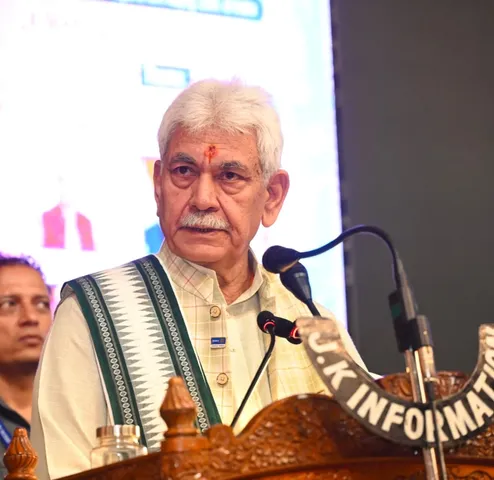
Srinagar, Aug 26: Jammu and Kashmir Lieutenant Governor Manoj Sinha on Wednesday asserted that advanced healthcare must become a fundamental right for every citizen rather than a privilege confined to affluent sections in metropolitan cities.
Addressing the Quaternary Healthcare and Research Summit at the Sher-i-Kashmir International Conference Centre (SKICC), the Lieutenant Governor emphasized that both the nation and the Union Territory must now transition from tertiary healthcare to cutting-edge quaternary-level treatment and advanced medical research.
Bridging the Healthcare Divide
Recalling a 2020 visit to Akhnoor during the “Back to Village” initiative, LG Sinha noted that the biggest challenge facing the UT is the disparity between services available at district-level facilities and actual specialized medical needs. He stressed that closing this gap is an urgent priority.
Highlighting the nationwide strides achieved under Prime Minister Narendra Modi, the LG pointed out:
- Free medical treatment provided to over 56 crore citizens.
- More than 37 crore consultations delivered through the e-Sanjeevani telemedicine network.
- Over 7 crore children covered under annual vaccination drives.
- Expansion of infrastructure to 23 AIIMS and over 2,000 medical colleges across India.
Focusing on the UT’s medical landscape, he highlighted that Jammu and Kashmir now hosts two AIIMS, 10 medical colleges, two State Cancer Institutes, specialized Bone & Joint and pediatric hospitals, alongside dozens of nursing and paramedical institutions.
Push for High-End Quaternary Infrastructure
LG Sinha called upon major hospitals to evolve into active research institutions offering organ transplantation, robotic precision surgery, advanced genomics, cellular therapies, and AI-driven diagnostics. He urged healthcare institutions to allocate dedicated annual budgets for advanced equipment, such as modern operating theaters and proton-beam therapy units.
Key proposals outlined by the Lieutenant Governor include:
- Healthcare Corridors: Establishing direct connectivity between district hospitals, tertiary centers, and quaternary institutions to speed up diagnostics, imaging, and specialist consultations.
- Specialist Training: Expanding fellowships in oncology, organ transplant, critical care, and genomics to meet high-level surgical and medical demands.
- Himalayan Biomedical Mission: Creating a collaborative research coalition involving Himalayan states, universities, and private innovators to drive domestic medical innovation.
Emphasizing equitable access, LG Sinha stated that a farmer’s child in a remote village should have the same access to life-saving quaternary care as an urban millionaire, urging stakeholders to view hospitals as strategic national assets.