

SCIENCE & TECHNOLOGY / SPACE DESK
Dawn of Private Space Era: Skyroot Aerospace Successfully Executes Maiden Orbital Launch of Vikram-1 Rocket from Sriharikota
In a defining victory for India’s private space industry under Mission Aagaman, the four-stage Vikram-1 vehicle precisely injected commercial payloads into Low Earth Orbit, making India only the third nation to achieve domestic private orbital launch capabilities.

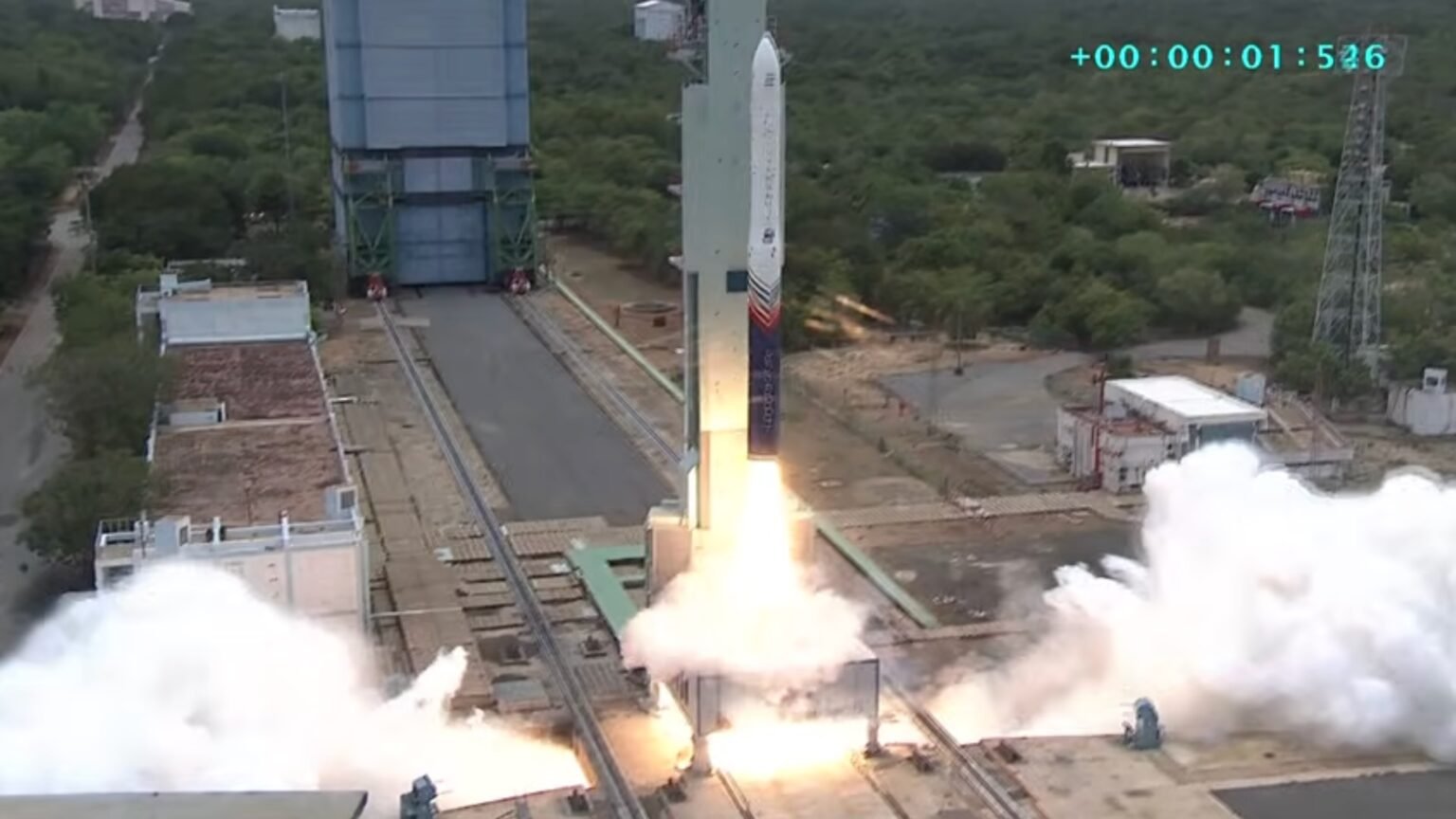
SRIHARIKOTA — India entered an elite global space league as Hyderabad-based space tech firm Skyroot Aerospace successfully executed the maiden orbital launch of its flagship rocket, Vikram-1, from the Satish Dhawan Space Centre (SDSC) SHAR in Sriharikota.
Operating under the mission name ‘Mission Aagaman’ (Sanskrit for “Arrival”), the seven-story rocket lifted off precisely from ISRO’s First Launch Pad. Approximately 17 minutes after ignition, the four-stage vehicle successfully deployed multiple satellites into a designated 450-kilometer Low Earth Orbit (LEO) at a 60-degree inclination.
With this successful deployment, India officially joins the United States and China as only the third nation in the world to possess fully functional private-sector orbital spaceflight capabilities.
Engineering Triumph: All-Carbon Composite Architecture
Named after Dr. Vikram Sarabhai, the father of the Indian Space Programme, Vikram-1 represents a massive leap forward in cost-effective aerospace manufacturing. Built entirely using an all-carbon composite body structure, the rocket features three solid-propellant lower stages and a liquid-fueled upper stage powered by the indigenously developed 3D-printed RAMAN-1 engine.
Designed to serve as an on-demand “cab service” for small satellites, Vikram-1 can haul up to 350 kilograms of payload into LEO. The launch was supported by technical facilitation, static motor testing, and safety oversight provided by ISRO and the Indian National Space Promotion and Authorization Centre (IN-SPACe) under the government’s liberalized Indian Space Policy framework.

Mission Aagaman: Payload Highlights & Commercial Satellites
The maiden flight carried an eclectic array of functional customer satellites alongside experimental technology demonstrators:
- SCOPE Satellite: Developed by Skyroot to collect real-time telemetry and flight dynamics performance metrics.
- SOLARAS S3: An Earth-observation technology satellite provided by private operator Grahaa Space.
- Embrace Robotic Arm: Created by Cosmoserve Space for testing active orbital debris mitigation techniques.
- Cultural & Heritage Tributes: The upper stage carried “Cosmic Bloom” (lab-grown diamond floral art) and an 18-karat gold micro-rocket incorporating microscopic engravings honoring scientific pioneers C. V. Raman, Dr. Vikram Sarabhai, and Dr. A. P. J. Abdul Kalam.
Vikram-1 Orbital Launch Performance Matrix
| Mission Attribute | Specification / Achievement |
|---|---|
| Launch Vehicle | Vikram-1 (4-Stage All-Carbon Composite Rocket) |
| Developer / Operator | Skyroot Aerospace (Hyderabad, India) |
| Launch Site | First Launch Pad, SDSC SHAR, Sriharikota |
| Payload Capacity | Up to 350 kg to Low Earth Orbit (LEO) |
| Target Orbit | 450 km altitude at 60° inclination |
| Global Milestone | India becomes 3rd nation with private orbital capability (after USA & China) |
“Executing the nation’s first fully private orbital flight proves our domestic space ecosystem is ready to lead end-to-end global commercial missions,” stated Lt. Gen. AK Bhatt (Retd.), Director General of the Indian Space Association.
Unlocking India’s $44 Billion Space Economy
With global demand for small satellite launches expanding rapidly, Skyroot’s successful orbital debut positions India to capture a substantial share of the global space logistics market. The achievement aligns with New Delhi’s strategy to expand the national space economy from $8 billion to $44 billion by 2033, opening doors for private launch providers, satellite manufacturers, and downstream space technology ventures.