



PM Modi Holds Grand Roadshow in Puducherry Amid Triangular Election Contest
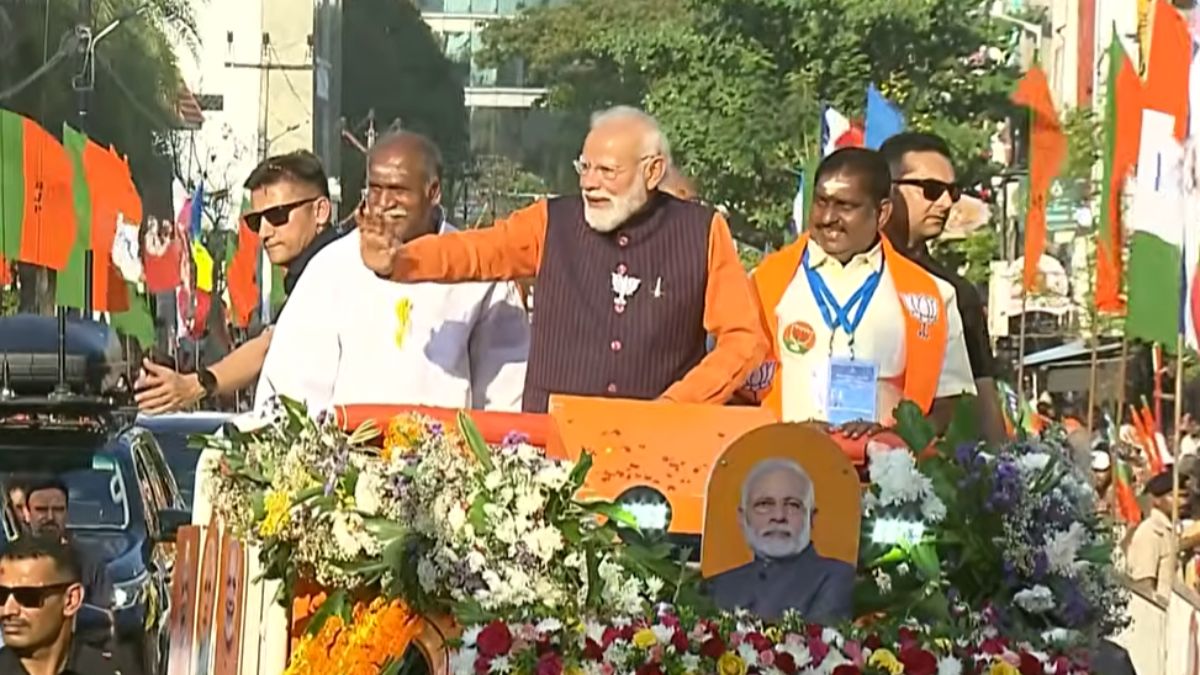
Puducherry Prime Minister Narendra Modi on Friday led a high‑voltage roadshow in Puducherry, turning the Union territory’s otherwise quiet streets into a sea of saffron and blue as the National Democratic Alliance (NDA) cranked up its campaign ahead of the April 9 Assembly polls. The event, which drew tens of thousands of supporters along a 2‑kilometre stretch from Ajanta Signal to Anna Square, underlined the BJP‑led coalition’s ambition to expand its political footprint in this coastal region and deepen its alliance with the ruling AINRC government.
Grand wheel‑show in the former French enclave
Modi arrived in Puducherry in the late afternoon, landing first at Chennai before being driven directly to the Union territory. From the Ajanta Signal junction, he boarded an open vehicle, flanked by Puducherry Chief Minister N. Rangasamy, AINRC leaders, and BJP functionaries, and began a roughly one‑hour procession through Anna Salai and adjoining boulevards. Roads were barricaded and security was tightened, with police, paramilitary, and local authorities coordinating checkpoints and crowd‑control measures to ensure smooth movement of the convoy.
Jam‑packed crowds lined the route, waving flags, holding party banners, and chanting slogans in support of the NDA. Cultural troupes, drummers, and local artists added colour to the procession, transforming the event into a hybrid of political rally and street festival. The Prime Minister repeatedly stopped the vehicle to greet supporters, acknowledging the cheers and applause with a wave, a namaskar, and brief exchanges with party workers positioned along the median.
Triangular contest shapes electoral arithmetic
The Puducherry Assembly comprises 30 seats, and this election is rapidly evolving into a triangular contest rather than a straightforward two‑front fight. On one side stands the ruling AINRC‑led NDA coalition, which includes the BJP, AIADMK, and the smaller LJK. On the other side is the Congress–DMK alliance, banking on Dravidian‑centric politics and anti‑incumbency sentiment. Between them, actor Vijay’s newly formed Tamilaga Vettri Kazhagam (TVK) has entered the fray, seeking to grab a share of the youth and urban vote.
For the BJP, the roadshow is more than a stagecraft exercise; it is a strategic move to project Modi as the face of stability and development in Puducherry. The party, which won six seats in the 2021 Assembly polls, now aims to increase its tally to nine or more, hoping to convert its current role as a junior partner into a stronger bargaining position within the AINRC‑led coalition.
Stress on governance and development blueprint
During the roadshow and in short remarks at the concluding point near the Kamarajar statue, Modi highlighted the NDA government’s record of governance at the Centre and linked it to Puducherry’s local development agenda. He spoke of infrastructure upgrades, digital connectivity, and social‑welfare schemes such as housing, health insurance, and women‑centric programmes, urging voters to see the NDA as a force for continuity and progress.
“We have transformed how the government reaches every doorstep, whether it is Aadhaar‑linked benefits, UPI‑based payments, or mission‑driven projects in roads, water, and electricity,” Modi reportedly said, positioning the central dispensation as a reliable partner for the Union territory’s growth. He also lauded the local administration’s efforts in sanitation, tourism promotion, and civic projects, while indirectly targeting the Congress–DMK combine as a “coalition of the past” unable to match the current pace of change.
Strains within alliances and internal churn
Beneath the celebratory veneer, both major alliances are grappling with internal tensions. Within the NDA, differences have surfaced over the inclusion of the LJK (led by lottery baron Martin’s son Charles), with the BJP questioning his local roots and political track record. The resistance has created quiet friction between the BJP and AINRC, even as Modi’s visit is designed to project unity.
On the opposition side, the Congress–DMK alliance is not without cracks. The Congress has denied a ticket to former Chief Minister V. Narayanasamy, a move that has sparked murmurs of discontent within the party’s grassroots. At least half a dozen rebel candidates are contesting against official nominees, raising the risk of vote‑splitting in crucial constituencies.
TVK and the youth–celebrity factor
The emergence of TVK adds a new layer to Puducherry’s electoral mathematics. Actor Vijay’s party, campaigning on a platform of youth opportunities, anti‑corruption, and social justice, is attempting to vacuum votes from all three main blocs. The roadshow route in Puducherry witnessed a visible number of youth and students, many of whom had earlier gathered at TVK’s own rallies, suggesting that the star‑power equation could influence swing seats in urban Puducherry and nearby regions.
Modi’s team, aware of this dynamic, sought to counter the TVK narrative by emphasising Modi’s long‑term association with Tamil Nadu and Puducherry voters, including past election campaigns and visit‑focused welfare schemes. Party workers distributed handouts and pamphlets highlighting central schemes implemented in the Union territory, from smart‑city‑style infrastructure in Puducherry town to expanded railway connectivity and tourism promotion.
Security and logistical preparations
Security agencies treated the roadshow as a high‑risk political event, deploying additional personnel at choke points, intersections, and near the airport. The route from Ajanta Signal to Anna Square was cordoned off hours in advance, with diversions imposed on regular traffic and local businesses advised to shift operations temporarily. Emergency services, including ambulances and fire tenders, were stationed along the stretch to respond to any incident.
Logistics were coordinated by the Puducherry police in consultation with the Prime Minister’s Office and the Union Home Ministry. The event concluded with a brief security‑review stop at the Chief Minister’s residence, after which Modi returned to Chennai for a night halt before participating in a closed‑door BJP leadership meeting on Saturday.
What this means for Puducherry politics
For Puducherry, Modi’s visit signals that the Union territory is no longer a political afterthought but a key frontier in the BJP’s southern‑expansion strategy. The triangular contest, with NDA, Congress–DMK, and TVK all vying for dominance, increases the likelihood of a fractured verdict, where no single alliance may secure a clean majority but the NDA hopes to emerge as the largest bloc.
Election analysts note that urban centres such as Puducherry town and Pondicherry University belt, along with coastal constituencies, will be decisive in determining outcomes. The BJP is banking on its improved cabinet presence—two BJP ministers already serve in Rangasamy’s Council of Ministers—to showcase its enhanced influence, while the Congress–DMK combine relies on its traditional Dravidian base and anti‑term‑governance sentiment.
Earlier political context and Modi’s southern outreach
Modi’s Puducherry roadshow is part of a broader southern campaign ahead of the Assembly elections. Earlier in the week, he addressed public meetings in Tamil Nadu’s capital Chennai, underlining the BJP’s ambition to make inroads beyond its traditional strongholds. The party frames this outreach as “unity of India”, arguing that Puducherry’s unique blend of Tamil, French colonial, and Union‑territory identity makes it a symbolic arena for national integration and development.
In the past, Puducherry has seen frequent changes in government, with weak alliances often collapsing before completing full terms. The NDA hopes that Modi’s high‑profile presence, combined with the image of a stable coalition at the Centre, will help reassure voters that the AINRC–BJP–AIADMK combine can deliver durable governance.
Local feedback and voter sentiment
Local residents along the roadshow route expressed mixed reactions. Some shopkeepers and small‑business owners praised the economic activity generated by the event, including increased footfall and temporary employment for security and logistics staff. A few youth workers interviewed near Anna Square said they were more attracted to the TVK’s message of “new generation politics” than to the established parties, even as they welcomed Modi’s presence.
However, middle‑aged residents and party cadres spoke of stability and continuity, citing ongoing infrastructure projects, better municipal services, and the feeling that Puducherry is getting “more connected” with national‑level development processes. For many, the saffron sea of the roadshow reinforced the image of Modi as a unifying leader committed to both national and regional progress.
Tags:
Like and Follow State Correspondents Facebook Page Latest International News Iran US War Subscribe for alerts© 2026 State Correspondents. All rights reserved.