



Centre Urges States to Crush LPG Hoarding & Black‑Marketing; Assures Stable Supply
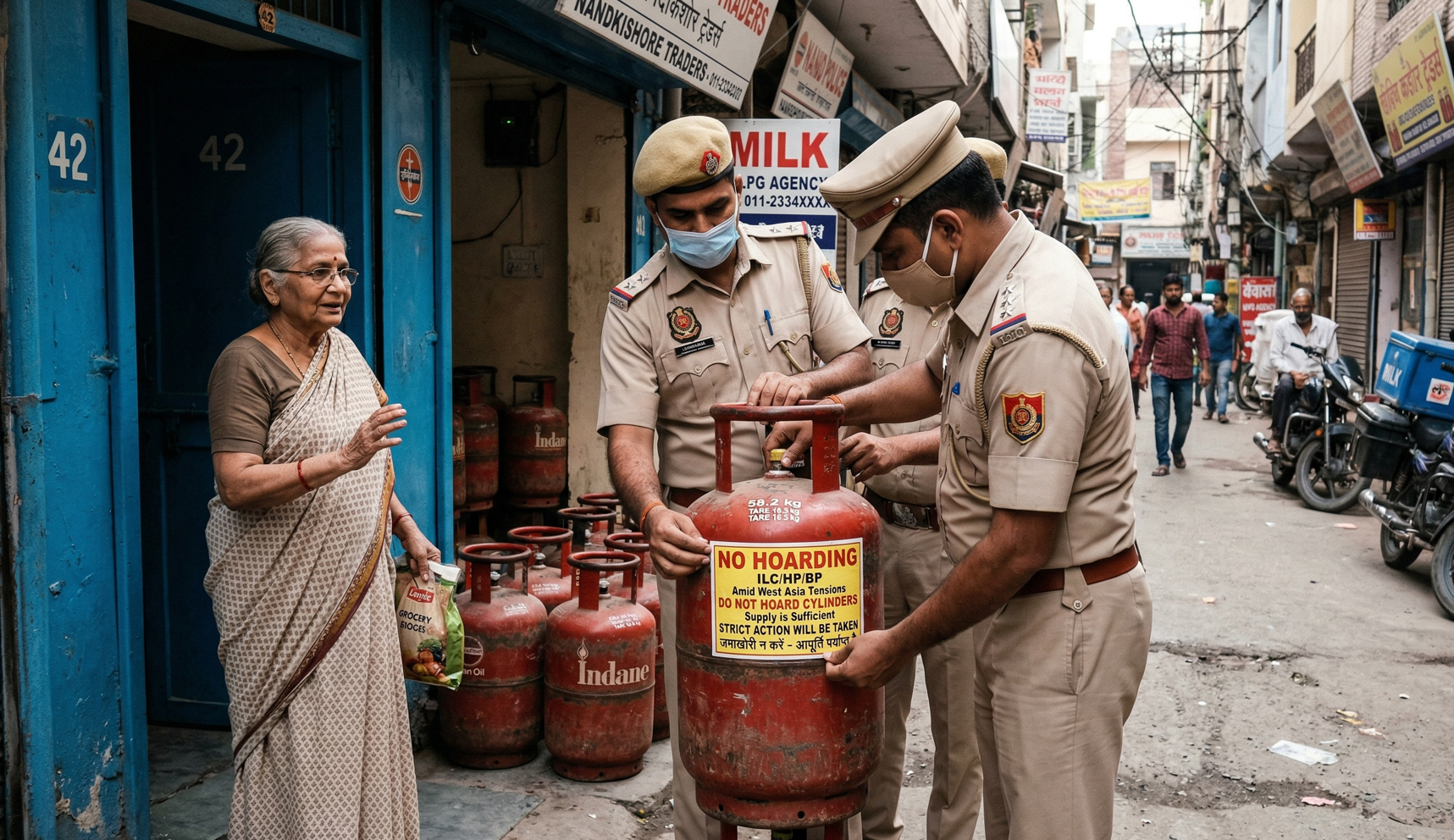
New Delhi The Centre has formally called on all states and Union Territories to clamp down rigorously on hoarding and black‑marketing of LPG and other petroleum products, even as it repeatedly reassures the public that domestic LPG supply remains stable and sufficient despite ongoing tensions in West Asia. The Ministry of Petroleum and Natural Gas (MoPNG) has issued fresh directives, invoked provisions under the Essential Commodities Act and the LPG Control Order, and asked state authorities to intensify raids, inspections, and public‑awareness campaigns to prevent panic buying and price manipulation.
Why the crackdown order was issued
The move comes in the wake of rising geopolitical anxiety triggered by the temporary closure of the Strait of Hormuz, rocket and missile attacks on Gulf‑region oil facilities, and disruptions in some crude‑oil shipping routes. Global markets have witnessed volatility in crude and LPG prices, and social‑media messages have circulated rumours of “impending LPG shortages” in India, leading to instances of panic booking and speculative storage of cylinders.
To counter such distortions, the Union government has stressed that India’s refineries are operating at high capacity and that crude inventories, along with finished‑fuel stocks, are amply stocked to meet domestic demand. At the same time, the Centre has signalled a “zero‑tolerance” approach toward those who exploit fears by illegally hoarding cylinders or diverting commercial LPG to the black market.
Strict directives under the Essential Commodities Act
In a detailed letter to all states and UTs, Petroleum Secretary Dr. Neeraj Mittal has reminded authorities of their powers under the Essential Commodities Act, 1955 and the LPG (Control) Order to regulate storage, distribution, and pricing. The Ministry has asked states to:
- Conduct frequent raids and inspections at LPG distributors’ godowns, retail outlets, and transport hubs.
- Monitor unusual bulk bookings and unauthorised stockpiling by commercial or industrial users.
- Take punitive action under the Essential Commodities framework, including search, seizure, and prosecution where necessary.
- Coordinate closely with public‑sector Oil Marketing Companies (Indian Oil, Bharat Petroleum, and Hindustan Petroleum) for real‑time intelligence and data sharing.
Officials have also been told to maintain strict vigilance against “misinformation” that can trigger panic demand, especially via social‑media groups and local messaging chains.
Raids, seizures, and action against distributors
Enforcement has already been scaled up across the country. According to MoPNG data cited by multiple agencies, enforcement agencies in more than 20 states and UTs have conducted over 4,000 raids to check LPG hoarding and black‑marketing in recent weeks. These operations have led to the seizure of more than 1,300 LPG cylinders and the detection of several bottlenecks in the distribution chain, including unauthorised inter‑state movement and sale of subsidised cylinders at higher prices.
Public‑sector oil marketing companies have also issued over 670 show‑cause notices to LPG distributors and retail agents suspected of malpractice, including booking manipulation, diversion to commercial users, and selling cylinders to unregistered consumers. In some states, licences have already been suspended or cancelled, and the Ministry is encouraging stricter penalties to deter repeat offenders.
Households assured: no shortage of domestic LPG
At the heart of the government’s messaging is a clear claim: domestic LPG supply for households remains stable, even as global tensions flare. Officials have explained that India’s LPG ecosystem is supported by a mix of domestic production and diversified imports, with refineries operating close to full capacity and existing inventories sufficient to meet normal household demand.
Joint Secretary Sujata Sharma of MoPNG has publicly stated that the “normal delivery cycle” for domestic LPG cylinders stands at roughly two‑and‑a‑half days from booking to delivery, and that there is no need for consumers to rush‑book or stock up cylinders. The Centre has also clarified that LPG supply to migrant workers and other vulnerable groups remains unaffected, with targeted distribution channels in place wherever needed.
West‑Asia tensions vs India’s energy strategy
West‑Asia tensions have rattled global energy markets, but India has taken several steps to insulate its domestic supply chain. Government data shows that the share of crude imports routed through the Strait of Hormuz has decreased, with around 70% of crude now sourced from non‑Hormuz routes, including the Americas, Central Asia, and other regions.
At the same time, LPG production has actually increased by about 30% in recent months, with refineries instructed to channel surplus output to the domestic household segment rather than export or industrial use. The Ministry has also introduced a 25‑day inter‑booking rule for domestic LPG connections in some affected states, designed to curb panic bookings without affecting genuine household needs.
| Aspect | Government stance / action |
|---|---|
| LPG supply for households | “Adequate and stable”; no panic buying advised |
| Hoarding / black‑marketing | Strict raids; over 4,000 raids, 1,300+ cylinders seized |
| Legal framework used | Essential Commodities Act + LPG Control Order |
| West‑Asia risk mitigation | 70%+ crude via non‑Hormuz routes; 30% LPG output rise |
| Alternate‑fuel push | Expansion of PNG, use of kerosene/coal to ease pressure |
Alternate fuels and PNG push to ease pressure
To further reduce strain on the LPG supply chain, the Centre has advised states to accelerate the switch of commercial and industrial users from LPG to piped natural gas (PNG). In several states, including Kerala and parts of northern India, commercial consumers such as hotels, restaurants, and industrial units are being mandated to secure PNG connections where available, with the warning that failure to migrate may invite future restrictions on LPG allocations.
Where PNG expansion is still underway, authorities are also turning to alternative fuels such as kerosene and coal to meet certain industrial and heating needs, particularly in small‑scale and micro‑enterprises. Emergency‑response portals and crisis‑management committees have been activated in a number of states to coordinate gas allocation to priority sectors like hospitals, schools, Anganwadis, crematoriums, and community kitchens.
Role of states: briefings, vigilance, and public trust
The Centre has urged states to be more visible in their communication with the public. At least 20–21 states and UTs have started holding regular press briefings or issuing press notes on LPG availability, pending deliveries, and enforcement actions, with the goal of calming public nerves and countering rumours. Some states have also launched dedicated helplines and web dashboards where consumers can check booking status and lodge complaints against dodgy distributors.
Officials have particularly praised the enforcement record of states like Uttar Pradesh, Gujarat, Haryana, Delhi, Maharashtra, and Andhra Pradesh for their aggressive raids and efficient coordination with oil marketing companies. The Centre has held review meetings with state petroleum and excise officials to share best practices and to tighten the monitoring of LPG logistics, from the refinery gate to the last‑mile delivery.
Message to citizens: avoid panic, report hoarding
A key pillar of the government’s strategy is behavioural—asking ordinary citizens not to succumb to fear‑driven behaviour. The Centre has repeatedly urged the public:
- Not to engage in “panic booking” of extra LPG cylinders beyond actual household needs.
- Not to accept cylinders offered at prices higher than the government‑fixed rate.
- To report suspected hoarding, black‑market activity, or unauthorised booking‑agents to local authorities or the MoPNG helpline.
At the same time, authorities are reminding users that those with a PNG connection should not hold a parallel domestic LPG supply, as this may invite regulatory action under the LPG Control Order.
What this means for Indian households and industry
For the average Indian household, the Centre’s message is straightforward: LPG for cooking will remain available on the usual timeline, but the government will not tolerate those who manipulate the system to create artificial scarcity. For small businesses and industries, the emphasis is on transitioning to stable, long‑term alternatives such as PNG or other fuels, rather than relying solely on LPG for cost‑arbitrage or speculative motives.
For state governments, the directive underscores the need to invest in better enforcement infrastructure—better data‑sharing with OMCs, faster complaint‑redressal mechanisms, and more visible communication during any crisis window. The LPG‑hoarding crackdown is also being treated as a test case of how India’s federated energy‑governance model functions under external shocks.
Tags:
Like and Follow State Correspondents Facebook Page Latest International News Iran US War Subscribe for alerts© 2026 State Correspondents. All rights reserved.